


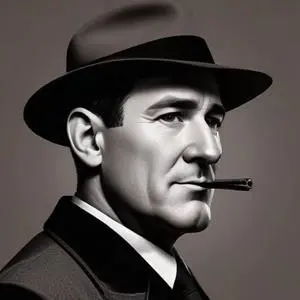
This Canadian-American engineer designed the iconic M1 Garand rifle, a legendary firearm that played a significant role in World War II and became an symbol of American ingenuity. He's revered for revolutionizing infantry combat with his innovative rifle design.
John Garand, a Canadian-American designer of firearms, is renowned for creating the M1 Garand, a semiautomatic rifle that revolutionized the military's firepower during World War II and the Korean War. This iconic weapon earned Garand a place in the annals of military history, and his legacy extends far beyond the battlefield.
Born on January 1, 1888, on a farm near St. Rmi, Quebec, Garand was one of twelve children. After his mother's passing in 1899, his father moved the family to Jewett City, Connecticut, where Garand learned to speak English while sweeping floors at a textile mill. It was here that he developed an interest in guns and shooting, which would become the foundation of his life's work.
Garand honed his machinist skills at the textile mill, which led to his employment at Browne and Sharpe, a Providence, Rhode Island, toolmaking company in 1909. Later, he worked for a New York toolmaking firm, where he refined his rifle skills at shooting galleries along Broadway. His passion for machinery and target shooting organically evolved into a hobby of designing guns, which took a vocational turn in 1917.
In 1917, the United States Army solicited bids for designs of a light machine gun, and Garand's submission was selected by the War Department. He was appointed to a position with the United States Bureau of Standards in Washington D.C., where he perfected his weapon. Although the first model wasn't built until 1919, too late for use in World War I, it paved the way for the M1 Garand, which would become the standard-issue rifle for the U.S. military during World War II.
The M1 Garand's impact on modern warfare was monumental. It introduced a new era of semiautomatic firepower, allowing soldiers to engage targets with increased accuracy and speed. Garand's design also pioneered the use of a self-loading mechanism, which reduced the need for manual reloading and improved the overall efficiency of combat operations.
John Garand's contributions to the world of firearms extend beyond his iconic rifle design. He leaves behind a legacy of innovation, precision, and dedication to his craft. His work has inspired generations of firearms designers, and his M1 Garand rifle remains an enduring symbol of American military might.
In conclusion, John Garand's life and work serve as a testament to the power of innovation and perseverance. His Semiautomatic rifle may have changed the face of warfare, but his legacy is a reminder that even the most seemingly complex machines are born from the imagination and creativity of human minds.
Born in 1922
An American engineer and weapons designer created the iconic AR-15 rifle, a lightweight, semi-automatic firearm that revolutionized modern combat and civilian shooting sports. This innovative design has had a lasting impact on the firearms industry.
Born in 1855
Founded the iconic firearms company, designing legendary guns like the M1911 pistol and Auto-5 shotgun, revolutionizing the industry with innovative designs. Known for creating reliable, durable, and accurate weapons that have stood the test of time.
Born in 1814
Founded the iconic firearms company that revolutionized the revolver industry, producing legendary guns like the Colt.45, which shaped the American West.
Born in 1840
Invented the first portable, fully automatic machine gun, revolutionizing warfare with its rapid firing capability. This innovation had a profound impact on modern combat.
Born in 1885
A renowned military leader who played a crucial role in World War II, particularly in the Allied victory in Europe, known for his bold tactics and unapologetic style.
Born in 1890
Led the Allied forces to victory in World War II and later served as President, maintaining peace and prosperity during the Cold War era. He's known for his strategic leadership and diplomatic skills.
Born in 1893
Led the US Army in World War II and became the last five-star general, playing a crucial role in shaping post-war American military strategy. He's also known for his humble and unassuming leadership style.
