


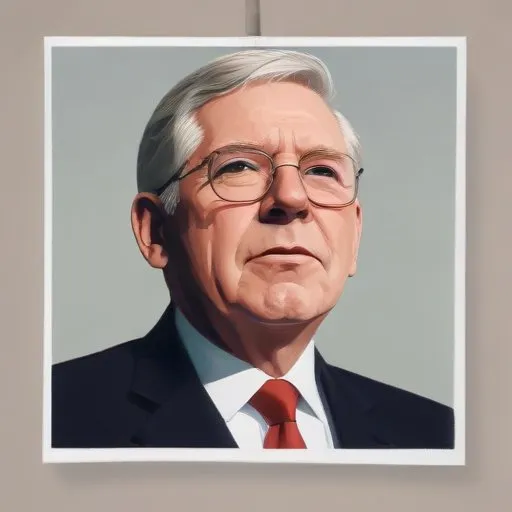
The 14th White House Chief of Staff, serving under President George H.W. Bush, is known for his influential role in shaping the administration's domestic and foreign policy agendas. He's also a skilled engineer with a Ph.D. in mechanical engineering.
Known for his remarkable tenure as the 75th Governor of New Hampshire and later as the White House Chief of Staff under President George H. W. Bush, John H. Sununu is a renowned American politician and engineer who has made a lasting impact on the nation's political landscape. With a unique blend of Greek, Hispanic, and Lebanese descent, Sununu has paved the way for diversity in politics, becoming the first Arab American, Greek American, and Hispanic American to hold these esteemed positions.
Born on July 2, 1939, in Havana, Cuba, to an American father and a Salvadoran mother, Sununu's family heritage is a testament to his diverse roots. His father, John Saleh Sununu, was an international film distributor, and his mother, Victoria Sununu (née Dada), was of Greek and Hispanic ancestry. Sununu's childhood was marked by a visit to Beirut, Lebanon, in the late 1940s, and he grew up in New York City.
After graduating from the La Salle Military Academy on Long Island, Sununu went on to earn his Bachelor of Science, Master of Science, and PhD degrees in mechanical engineering from the Massachusetts Institute of Technology (MIT). He was a member of the Phi Sigma Kappa fraternity and developed a strong foundation in engineering that would later influence his political career.
Sununu's academic background served him well in his early career as an associate professor of mechanical engineering at Tufts University, where he taught from 1966 to 1982. He later became the associate dean of the university's College of Engineering from 1968 to 1973. This experience laid the groundwork for his entrance into politics.
In 1983, Sununu was elected as the Governor of New Hampshire, a position he held until 1989. During his tenure, he focused on economic development, education, and environmental issues. His success in these areas led to his appointment as the White House Chief of Staff under President George H. W. Bush in 1989, a role he held until 1991.
Sununu's political career has been marked by several milestones, including his role as the chairman of the New Hampshire Republican Party from 2009 to 2011. He has also been instrumental in shaping the careers of his sons, John E. Sununu and Christopher Sununu, who have followed in his footsteps as politicians.
Throughout his life, Sununu has been driven by a commitment to public service and a passion for engineering. His legacy serves as a testament to the power of diversity and the importance of fostering leaders who can bring unique perspectives to the table.
Sununu's political philosophy has been shaped by his experiences as an engineer and a politician. He believes in the importance of pragmatic solutions and has been known for his ability to work across party lines to achieve common goals.
Through his work, Sununu has demonstrated a deep commitment to the principles of public service, emphasizing the need for leaders to be accountable to their constituents and to prioritize the greater good.
Sununu's personal life has been marked by several significant milestones, including his marriage to his wife, Nancy, and the birth of his two sons, John E. and Christopher.
In addition to his political achievements, Sununu has been recognized for his contributions to the engineering community, including his induction into the National Academy of Engineering in 1990.
Sununu's impact on modern society extends beyond his political career. As a trailblazer for diversity in politics, he has paved the way for future generations of leaders from underrepresented backgrounds.
Through his work in engineering and politics, Sununu has demonstrated the importance of interdisciplinary approaches to problem-solving, highlighting the value of diverse perspectives in addressing complex challenges.
"I think what's most important is that we recognize that we're all in this together, and that we have to work together to find solutions that benefit everyone." - John H. Sununu
This quote encapsulates Sununu's commitment to public service and his belief in the power of collaboration and compromise.
Sununu's legacy is deeply rooted in the historical context of American politics in the late 20th century. His rise to prominence during the Reagan and Bush administrations marked a significant shift in the Republican Party's approach to diversity and inclusion.
As a pioneer in his field, Sununu has left an indelible mark on the political landscape, inspiring future generations of leaders to follow in his footsteps.
Born in 1924
The 41st President of the United States, a decorated war hero and skilled diplomat, led the country through the end of the Cold War and Gulf War. He's known for his foreign policy expertise and "kinder, gentler nation" vision.
79 Years Old
The 44th Vice President of the United States, a lawyer, and politician who served under President George H.W. Bush from 1989 to 1993, known for his conservative views and infamous misspelling of "potato" as "potatoe".
85 Years Old
The 46th Vice President of the United States, a powerful and influential figure in American politics, known for his strong conservative stance and role in shaping the country's foreign policy during the War on Terror.
94 Years Old
The 13th United States Secretary of Defense, a high-ranking government official, oversaw the US military during the Iraq War and was known for his controversial decisions and quotes. He's infamous for his "known unknowns" phrase.
89 Years Old
The first African American to serve as Secretary of State, he played a crucial role in shaping US foreign policy during the Gulf War and War on Terror. He's also known for his diplomatic efforts and leadership in the military.
Born in 1925
A highly respected military strategist and diplomat who served as the 9th United States National Security Advisor, playing a crucial role in shaping foreign policy and national security decisions.
96 Years Old
The 61st United States Secretary of State, a skilled diplomat and strategist, played a crucial role in shaping global politics during the Gulf War and beyond. He's known for his exceptional negotiation skills and ability to build international coalitions.
86 Years Old
A media mogul who transformed the American news landscape with his pioneering work in cable news, creating a powerful platform for conservative voices.
