


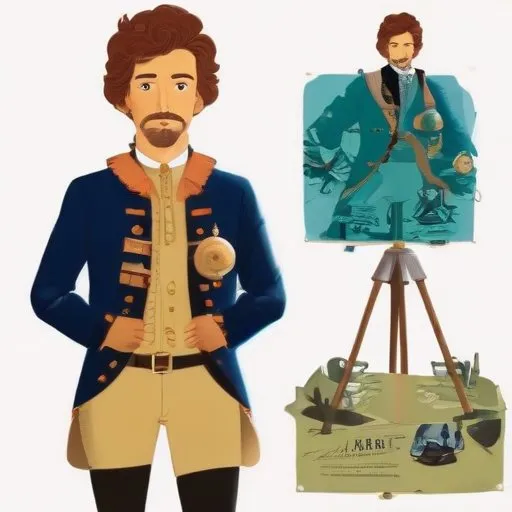
A Scottish explorer and surveyor who led the first successful expedition to cross Australia from south to north, opening up the continent to further exploration and settlement.
John McDouall Stuart is renowned for being the first explorer to successfully traverse the Australian mainland from south to north and return, paving the way for the annexation of the Northern Territory. This monumental feat, achieved in 1862, cemented Stuart's status as one of the most accomplished inland explorers in Australian history.
Born on September 7, 1815, in Dysart, Fife, Scotland, Stuart was the youngest of nine children. After his parents' death in his early teens, he came under the care of relatives. Stuart graduated as a civil engineer from the Scottish Naval and Military Academy before emigrating to Australia at the age of 23.
Upon arriving in South Australia in 1839, Stuart found employment with the colony's Surveyor-General, working in the semi-arid scrub of the newly settled districts. He soon gained experience marking out blocks for settlers and miners, which would later prove invaluable in his expeditions.
Stuart's expeditions were a testament to his unwavering determination and exceptional leadership skills. He led six expeditions between 1858 and 1862, covering over 29,000 kilometers of uncharted territory. His experience and care for his team ensured that he never lost a man, despite the harsh conditions they faced.
The most significant of these expeditions was the 1861-1862 journey, which saw Stuart's party traverse the continent from south to north and return, a distance of approximately 4,800 kilometers. This achievement not only opened up new land for settlement but also facilitated the construction of the Australian Overland Telegraph Line in 1871-1872, which followed Stuart's route.
Stuart's expeditions had a profound impact on the development of Australia. The annexation of the Northern Territory in 1863, which was largely a result of Stuart's explorations, expanded the country's territory and paved the way for further settlement and economic growth.
The principal road from Port Augusta to Darwin, established in the late 19th century, largely followed Stuart's route and was officially named the Stuart Highway in 1942 in his honor. Today, this highway remains a vital transportation link between southern and northern Australia.
Stuart was a slight, delicately built man, standing at approximately 5'6" (168 cm) and weighing less than 9 stone (54 kg). Despite his physical appearance, he was known for his resilience and determination, which served him well in the harsh Australian outback.
Stuart's personal life remains somewhat of an enigma, with little known about his relationships or personal struggles. However, his dedication to his work and his country is undeniable, and his legacy continues to inspire Australians to this day.
Stuart's contributions to Australian exploration and development were recognized during his lifetime. He was awarded the Royal Geographical Society's Founder's Medal in 1861, a testament to his outstanding achievements in the field of geography and exploration.
In conclusion, John McDouall Stuart's legacy is a testament to the power of human determination and perseverance. His expeditions and discoveries have had a lasting impact on Australian history, and his name remains synonymous with bravery and adventure in the Australian outback.
Born in 1847
First Premier of Western Australia, instrumental in the state's early development and exploration, known for his pioneering spirit and leadership.
