


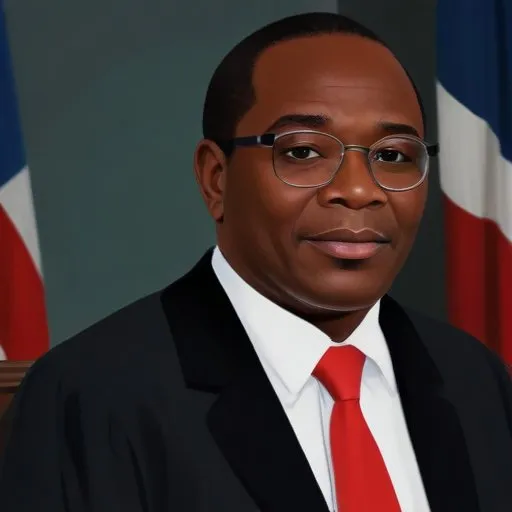
The 18th Chief Justice of Liberia, a prominent figure in the country's judiciary and politics, known for shaping Liberia's legal system and contributing to its governance.
Johnnie N. Lewis, a renowned Liberian lawyer and politician, is best known for serving as the 18th Chief Justice of Liberia from 2006 to 2012. During his tenure, he worked tirelessly to uphold the country's judicial system and promote justice, earning him a reputation as a stalwart defender of the law.
Born on April 16, 1946, in Greenville, Sinoe County, Liberia, Johnnie Lewis was raised in a family of intellectuals. His father, Roderick N. Lewis, was a lawyer, while his mother, Mary Houston Lewis, was a school teacher. He had three brothers and two sisters.
Lewis's educational journey began at St. Joseph's Catholic Elementary School, followed by Sinoe High School. He then attended the University of Liberia in Monrovia, where he earned a Bachelor of Arts and a Bachelor of Laws from the Louis Arthur Grimes School of Law. During his time in law school, he served as the editor of the Liberian Law Journal and graduated cum laude in 1969.
After being called to the bar in 1969, Lewis traveled to the United States to pursue a Master of Laws at Yale Law School, which he completed in 1971. Upon his return to Liberia, he was admitted to practice before the Supreme Court of Liberia and became an Associate Professor at his alma mater, the Louis Arthur Grimes School of Law.
In 1975, President William R. Tolbert, Jr. appointed Lewis as Judge of the Third Judicial Circuit Court in Sinoe County, a position previously held by his late father. After the government fell in a coup in 1980, Lewis left the judiciary and resumed his faculty position. He became the Dean of the Louis Arthur Grimes School of Law in 1984, a position he held until 1991.
In 1991, Lewis served as a legal adviser to the interim Liberian president. However, his private practice was not without challenges. In one harrowing incident, his home was invaded by gunmen searching for him, resulting in the tragic death of his nephew, who was killed for failing to disclose Lewis's whereabouts.
Despite these challenges, Lewis continued to thrive, becoming a partner in the Lewis & Lewis Law Offices of Monrovia. Between 1993 and 2003, he spent time outside of Liberia, but his dedication to his country and its people remained unwavering.
As Chief Justice of Liberia, Lewis worked tirelessly to strengthen the country's judicial system, promoting justice and upholding the rule of law. His contributions to Liberia's legal landscape are undeniable, and his legacy continues to inspire future generations of lawyers and judges.
Through his remarkable career, Johnnie Lewis has demonstrated unwavering dedication to his country and its people, earning him a revered place in Liberia's history. His commitment to justice, education, and the rule of law serves as a beacon of hope for a brighter future.
"The law is not just a set of rules, but a guiding principle for JUSTICE and equality. As lawyers, it is our duty to uphold the law and fight for the rights of all citizens."
88 Years Old
The first female head of state in Africa, she led Liberia through a period of reconstruction and reconciliation, and was awarded the Nobel Peace Prize for her efforts to promote peace and women's rights.
Born in 1809
First President of Liberia, leading the country to independence and self-governance, and a historian who documented the nation's early years.
85 Years Old
A renowned expert on Soviet politics and Nikita Khrushchev's biography, shedding light on the Cold War era through meticulous research and engaging writing.
78 Years Old
Former warlord who led Liberia through a brutal civil war and was later convicted of war crimes and crimes against humanity. He's infamous for his role in fueling regional instability and human rights abuses.
