


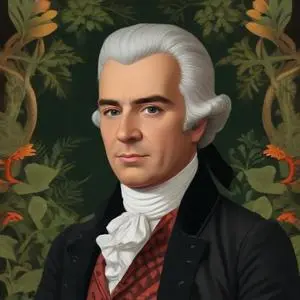
A British naturalist who sailed with Captain Cook on the HMS Endeavour, discovering and cataloging thousands of plant species, and advising on the development of the British colonies. He's considered the "father of Australian botany".
Renowned for his groundbreaking expeditions and tireless advocacy for the natural sciences, Sir Joseph Banks is celebrated as one of the most influential figures of the 18th century. As a naturalist, botanist, and patron of the sciences, Banks left an indelible mark on the world of botany, exploration, and beyond.
Born on February 13, 1743, in Argyll Street, Soho, London, Banks was the son of William Banks, a wealthy Lincolnshire country squire and member of the House of Commons. He was educated at Harrow School from the age of nine and later at Eton College, where he developed a keen interest in nature and history.
In 1766, Banks embarked on a natural history expedition to Newfoundland and Labrador, which marked the beginning of his illustrious career. This journey not only earned him recognition but also laid the foundation for his subsequent adventures.
Between 1768 and 1771, Banks joined Captain James Cook on his first great voyage, visiting Brazil, Tahiti, New Zealand, and Australia. This monumental journey cemented Banks' reputation as a leading naturalist and introduced him to the wonders of the Pacific.
For over 41 years, Banks held the prestigious position of president of the Royal Society, where he championed the sciences and supported numerous expeditions. His influence extended to the establishment of the Royal Botanic Gardens, Kew, which became the world's leading botanical garden under his guidance.
Banks had a younger sister, Sarah Sophia Banks, and his future shipmate, Constantine Phipps, was among his schoolmates at Eton College. He was also known for his strong relationships with King George III and the British government, which he advised on Australian matters.
Banks' contributions to the natural sciences, exploration, and colonization have had a profound impact on modern society. His advocacy for the sciences and his tireless efforts to collect and document plant specimens have enriched our understanding of the natural world.
Banks was honored with a baronetcy in 1781 and was elected a Fellow of the Royal Society in 1766. Today, his name is commemorated in the genus Banksia, and over 80 species of plants bear his name.
Sir Joseph Banks' remarkable journey, marked by curiosity, passion, and dedication, has inspired generations of scientists, explorers, and enthusiasts. His legacy continues to thrive, a testament to the power of human discovery and exploration.
Born in 1707
Developed the system of binomial nomenclature, which is still used today to classify and name living organisms. This system has had a profound impact on the fields of biology, ecology, and conservation.
41 Years Old
A Welsh rugby union player who captained Wales and the British and Irish Lions, known for his exceptional skill and leadership on the pitch.
Born in 1744
A French soldier, biologist, and academic who developed a theory of inheritance of acquired characteristics, proposing that organisms adapt to their environment and pass on those traits to their offspring.
