


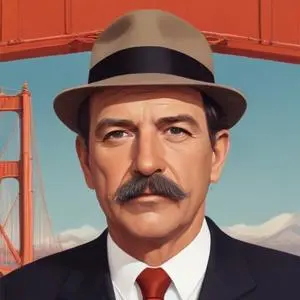
Co-designer of the iconic Golden Gate Bridge, a legendary feat of engineering that has become a symbol of San Francisco and American ingenuity.
Joseph Strauss was a pioneering American structural engineer who revolutionized the design of bascule bridges, leaving an indelible mark on the world of engineering and architecture. He is best known for his iconic design of the Golden Gate Bridge in San Francisco, California, a feat that has become synonymous with innovation and excellence.
Born on January 9, 1870, in Cincinnati, Ohio, to a family of German-Jewish ancestry, Strauss was exposed to the world of art and creativity from a young age. His mother was a pianist, and his father, Raphael Strauss, was a writer and painter. This artistic upbringing instilled in him a passion for poetry, which he would later pursue alongside his engineering career.
During his college days at the University of Cincinnati, Strauss was hospitalized and had a room with a view of the John A. Roebling Suspension Bridge. This chance encounter sparked his interest in bridges, and he went on to graduate in 1892 with a degree in civil engineering. After working under Ralph Modjeski, a renowned bridge-builder, Strauss proposed a radical idea – using cheaper concrete counterweights instead of expensive iron ones in bascule bridges. When his idea was rejected, he took a bold step and started his own firm, the Strauss Bascule Bridge Company of Chicago, where he would go on to revolutionize the design of bascule bridges.
Strauss's innovative designs led to the creation of some of the most iconic bridges of the 20th century. His portfolio includes the Burnside Bridge (1926) in Portland, Oregon, and the Lewis and Clark Bridge (1930) over the Columbia River between Longview, Washington, and Rainier, Oregon. However, it was his work on the Golden Gate Bridge that cemented his place in history.
The Golden Gate Bridge, completed in 1937, was a marvel of engineering that redefined the possibilities of bridge-building. Strauss's design not only reduced construction costs but also created a visually stunning structure that has become an symbol of San Francisco. His poem, "The Mighty Task is Done," written after the bridge's completion, is a testament to his pride and passion for his work.
Apart from his engineering prowess, Strauss was a man of many talents. He was an avid poet and writer, and his love for literature was reflected in his hobbies. He was also a devoted family man and a proud member of the Sigma Alpha Epsilon fraternity.
Joseph Strauss's contributions to the world of engineering and architecture are immeasurable. His innovative designs, passion for poetry, and commitment to his craft have inspired generations of engineers and architects. Today, his statue stands proudly on the San Francisco side of the Golden Gate Bridge, a testament to his enduring legacy.
Strauss's remarkable journey came to an end on May 16, 1938, in Los Angeles, California, just a year after the Golden Gate Bridge's completion. He is interred at Forest Lawn Memorial Park in Glendale, California, leaving behind a legacy that continues to inspire and awe people around the world.
Joseph Strauss's story is a testament to the power of innovation, creativity, and perseverance. His remarkable achievements serve as a reminder that with determination and passion, we can leave an indelible mark on the world. As we gaze upon the majestic Golden Gate Bridge, we are reminded of the visionary who dared to dream big and change the course of history.
Born in 1832
Co-designer of the iconic Eiffel Tower, a pioneering engineer who revolutionized bridge building and urban infrastructure with innovative iron constructions.
