


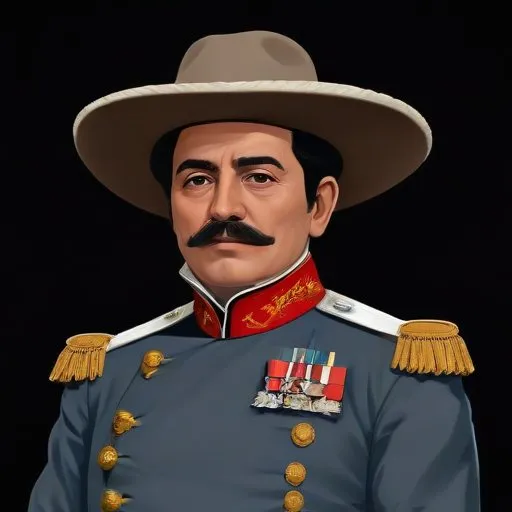
A brief but significant figure in Mexican history, he served as a general and president, playing a crucial role in the country's struggle for independence and reform. He's most known for his efforts to modernize and liberalize Mexico.
Juan lvarez, a name synonymous with revolution and reform, is renowned for his pivotal role in shaping Mexico's political landscape. As a general, regional leader, and president, lvarez fought tirelessly to protect the rights of indigenous peasants and championed universal male suffrage and municipal autonomy.
Born on January 27, 1790, in the town of Santa Maria de la Concepcion Atoyac, lvarez was the son of Antonio lvarez from Santiago Galicia and Rafaela Hurtado from Acapulco. He received his education in Mexico City under the direction of Ignacio Aviles, who later went on to educate lvarez's first son.
lvarez's involvement in the Mexican War of Independence began in 1810, when he joined the forces of Jos Mara Morelos as part of the second battalion of the Guadalupe Regiment. He rapidly rose through the ranks, becoming a sergeant within a month and a colonel less than a year later. This marked the beginning of his illustrious military career, which saw him fight in multiple wars, including the Pastry War, the Mexican-American War, and the War of the Reform.
In 1854, lvarez led a revolution in support of the Plan de Ayutla, a movement that aimed to topple the authoritarian government of Antonio Lpez de Santa Anna. This revolution marked the beginning of the Liberal Reform, a pivotal era in Mexico's history that saw the implementation of liberal policies and the development of a more democratic government.
After the ousting of Santa Anna, lvarez served as president of Mexico for two months in 1855, making him the first peasant-born president in Mexican history. His presidency was marked by a commitment to reform and the protection of indigenous rights. According to historian Peter Guardino, lvarez was instrumental in championing the incorporation of Mexico's peasant masses into the polity of Mexico.
Despite his many achievements, lvarez's presidency was not without controversy. Critics accused him of being too radical and of prioritizing the interests of indigenous peasants over those of the wealthy elite. However, his commitment to reform and his willingness to challenge the status quo earned him a reputation as a champion of democracy and social justice.
lvarez's political philosophy was rooted in a deep commitment to liberalism and federalism. He believed in the importance of empowering local communities and protecting the rights of indigenous peoples. His advocacy for universal male suffrage and municipal autonomy reflected his conviction that power should be decentralized and that citizens should have a greater say in their own governance.
lvarez's legacy continues to be felt in modern Mexico. His commitment to reform and his advocacy for indigenous rights have inspired generations of politicians and activists. His presidency marked a turning point in Mexico's history, paving the way for a more democratic and inclusive government.
Juan lvarez's story is a testament to the power of conviction and the importance of standing up for what is right. As a champion of democracy and social justice, he remains an inspiration to people around the world.
Born in 1794
A charismatic and cunning leader who dominated Mexican politics for decades, known for his role in the Texas Revolution and multiple presidential terms.
Born in 1806
A champion of democracy and indigenous rights, he modernized Mexico, abolished slavery, and limited church power. He's revered as a national hero for his progressive reforms.
Born in 1832
Unconstitutional president of Mexico who briefly seized power in 1832, known for his short-lived and tumultuous reign.
