


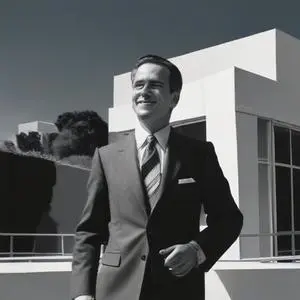
A pioneering architectural photographer who captured the essence of modernist buildings and their relationship with the environment, leaving an indelible mark on the world of architecture and design.
Julius Shulman, the renowned American architectural photographer, is best known for his iconic image of Case Study House 22, Los Angeles, 1960, also known as the Stahl House, which has become synonymous with midcentury modern architecture. His photography not only captured the essence of California's modernist movement but also spread its aesthetic globally, inspiring a new appreciation for the style.
Shulman was born on October 10, 1910, in Brooklyn, New York, to Ukrainian-Jewish parents. He grew up on a small farm in Connecticut before moving to Los Angeles as a young boy. Shulman briefly attended the University of California, Los Angeles, and the University of California, Berkeley, where he earned pocket money by selling his photographs to fellow students.
In 1936, Shulman returned to Los Angeles, where he worked as a draftsman for architect Richard Neutra. It was during this time that he began taking photographs of Neutra's buildings, which eventually led to his career as an architectural photographer. Shulman's unique perspective and ability to capture the essence of modernist architecture quickly gained him recognition, and he went on to collaborate with numerous architects, including Pierre Koenig and Charles Eames.
Shulman's photography is characterized by its clarity, simplicity, and ability to evoke a sense of calm. He believed that architectural photography should be considered an independent art form, where the photographer's perception and understanding of the building and its surroundings inform the final image. This approach has inspired generations of photographers and architects alike.
Shulman's vast library of images is now housed at the Getty Center in Los Angeles, a testament to his significant contribution to the world of architecture and photography. His contemporaries include Ezra Stoller and Hedrich Blessing Photographers, and his work has been published in numerous books and exhibitions worldwide.
In 1947, Shulman commissioned architect Raphael Soriano to build a midcentury steel home and studio in the Hollywood Hills, where he lived until his passing on July 15, 2009.
Throughout his life, Shulman remained committed to his craft, continued to inspire generations of photographers and architects, and left an indelible mark on the world of architecture and photography.
As we reflect on Shulman's remarkable legacy, we are reminded of the power of photography to capture the essence of a moment, a style, and an era. Julius Shulman's work continues to inspire us to appreciate the beauty of modernist architecture and the importance of preserving our cultural heritage.
Born in 1892
A pioneering architect who designed iconic buildings that blended seamlessly into their surroundings, revolutionizing modernist architecture with his sleek, functional, and elegant style.
Born in 1867
Visionary architect behind iconic, harmonious structures that blend seamlessly into their surroundings, redefining modern American architecture.
Born in 1910
A Finnish-American architect and furniture designer who created iconic, futuristic structures and designs that blended art and functionality, including the iconic Gateway Arch.
