


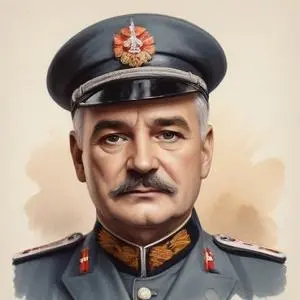
A Polish leader who played a crucial role in regaining Poland's independence after World War I and served as the country's prime minister, known for his military prowess and statesmanship.
Józef Piłsudski, a Polish statesman, is revered as the chief architect of Poland's independence in the aftermath of World War I. As the country's first Marshal and Chief of State, he played a pivotal role in shaping Poland's foreign policy and forging its path towards modernization.
Born on December 5, 1867, in Zułów, Russian Partition (now Lithuania), Piłsudski was exposed to the tumultuous world of Polish politics from an early age. His family, rooted in the Polish-Lithuanian Commonwealth's cultural heritage, instilled in him a deep sense of nationalism and a desire for independence.
Piłsudski's political career began in the early 1900s as a leader of the Polish Socialist Party. Convinced that Poland's freedom would only be achieved through military struggle, he formed the Polish Legions in 1914. This move marked the beginning of his ascendancy as a national hero.
In a remarkable display of foresight, Piłsudski predicted the outbreak of a major war in 1914, which would ultimately defeat the Russian Empire and the Central Powers. This prophecy earned him admiration and recognition within Polish circles.
As Poland regained its independence in 1918, Piłsudski became the country's Chief of State, a position he held until 1922. During this period, he commanded Polish forces in six wars that redefined the country's borders, cementing his reputation as a skilled military strategist.
In August 1920, on the brink of defeat in the Polish-Soviet War, Piłsudski's forces achieved a stunning victory at the Battle of Warsaw, repelling the invading Soviet Russian army and ensuring Poland's sovereignty.
In 1923, Piłsudski retired from active politics, but returned to power in 1926 following the May Coup. He went on to dominate Polish politics until his death on May 12, 1935. Piłsudski's legacy extends far beyond his military prowess; he is remembered as a champion of democracy, a fierce defender of minority rights, and a visionary leader who shaped modern Poland.
Piłsudski's philosophy was rooted in the ideals of the Polish-Lithuanian Commonwealth, which emphasized a multi-ethnic Poland as a "home of nations." He believed in the importance of preserving Poland's cultural heritage and promoting unity among diverse ethnic and religious groups.
Piłsudski's impact on modern Poland is immeasurable. He not only secured the country's independence but also shaped its foreign policy, promoted democratic values, and championed minority rights. His legacy continues to inspire generations of Poles and remains a beacon of hope for nations striving for self-determination.
