


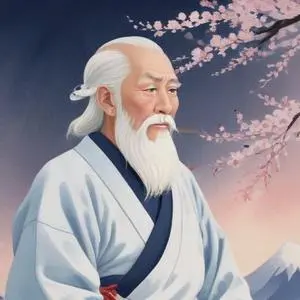
A renowned Japanese artist and printmaker, famous for creating vibrant, dreamlike ukiyo-e woodblock prints, including the iconic "The Great Wave off Kanagawa".
Katsushika Hokusai is renowned for his breathtaking woodblock print series, Thirty-Six Views of Mount Fuji, which includes the iconic The Great Wave off Kanagawa, a work that has captivated art enthusiasts worldwide. As a multifaceted Japanese ukiyoe artist, Hokusai's innovative style and boundless creativity have made an indelible mark on the world of art, influencing masters like Vincent van Gogh and Claude Monet.
Hokusai was born in 1760, in the Katsushika district of Edo (now Tokyo), to an artisan family. His early life was marked by a fascination with art, and he began his training as a young child. This dedication would eventually yield an astonishing output of over 30,000 paintings, sketches, woodblock prints, and book illustrations throughout his long and illustrious career.
Hokusai's contribution to the development of ukiyoe, a style of Japanese art that originally focused on portraiture, cannot be overstated. He revolutionized the genre by expanding its scope to encompass landscapes, plants, and animals, elevating ukiyoe to new heights of artistic expression. His innovative compositions and exceptional drawing technique have cemented his status as one of the greatest masters in the history of art.
It is impossible to discuss Hokusai without mentioning his most famous series, Thirty-Six Views of Mount Fuji, created in response to Japan's domestic travel boom and his own fascination with the majestic mountain. Two prints from this series, The Great Wave off Kanagawa and Fine Wind, Clear Morning, have become synonymous with Japanese art and have secured Hokusai's international fame.
Hokusai's artistic philosophy was deeply rooted in his spiritual beliefs. He was a devout Buddhist and believed that his art was a means to attain spiritual enlightenment. This worldview is reflected in his works, which often depict nature as a symbol of the infinite and the eternal.
Hokusai's influence extends far beyond the realm of Japanese art. His works have inspired generations of artists, from the Impressionists to contemporary artists, and continue to influence the development of modern art. His innovative style and boundless creativity have also inspired countless designers, architects, and musicians, making him a true trailblazer in the world of art.
At the age of 70, Hokusai embarked on a journey to the sacred mountain of Nikko, where he spent three months creating a series of drawings. This pilgrimage marked a turning point in his life, as he became increasingly fascinated with the spiritual and mystical aspects of art.
Hokusai's unwavering dedication to his art, despite facing numerous setbacks and personal struggles, serves as a testament to the power of perseverance and passion. His story is a reminder that creativity and innovation can flourish at any age, and that one's pursuit of artistic expression can bring joy and fulfillment to oneself and others.
As we gaze upon Hokusai's sublime works, we are reminded of the boundless potential of human creativity and the importance of pursuing one's passion, no matter the age or adversity. His legacy continues to inspire and captivate, ensuring that the art world will always be enriched by the brilliant spirit of Katsushika Hokusai.
