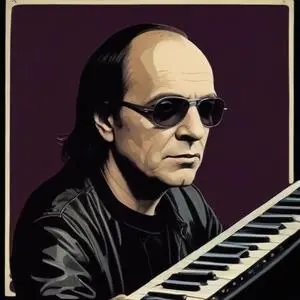
Klaus Schulze: The Visionary of Electronic Music
A Pioneer in Sound and Composition
Klaus Schulze is a German electronic music pioneer, composer, and musician, renowned for his innovative and influential work in the realm of electronic music. With a career spanning over six decades, Schulze has released more than 60 albums, cementing his position as a master of his craft.
Early Life and Career
Born on August 4, 1947, in Berlin, Germany, Schulze grew up in a family of artists. His father was a writer, and his mother was a ballet dancer. After completing his education, Schulze worked as a telegram delivery person and studied German at the Technical University of Berlin. His early musical endeavors began as a drummer in various bands, including Psy Free and Tangerine Dream, with whom he released the debut album "Electronic Meditation" in 1969.
Krautrock and the Birth of Solo Career
In 1970, Schulze left Tangerine Dream to form Ash Ra Tempel with Manuel Göttsching and Hartmut Enke. After releasing one album with the group, Schulze embarked on a solo career, releasing his debut album "Irrlicht" in 1972. This groundbreaking album, featuring organ and filtered orchestral recordings, is regarded as a landmark in electronic music.
Protoambient and the Rise to Prominence
Schulze's follow-up album, "Cyborg" (1973), introduced the EMS VCS 3 synthesizer, further solidifying his position as a pioneer of electronic music. His subsequent albums, such as "Timewind" (1975), "Moondawn" (1976), and "Dune" (1979), showcased his mastery of the Moog synthesizer and his ability to craft immersive, atmospheric soundscapes.
A Legacy of Innovation and Influence
Throughout his career, Schulze has been lauded for his innovative approach to electronic music, pushing boundaries and exploring new sonic territories. His influence can be seen in the work of numerous artists, from ambient and techno to rock and pop. Schulze's legacy extends beyond his own music, having contributed to the evolution of electronic music as a whole.
Major Works and Career Highlights
- "Irrlicht" (1972) - Debut solo album, considered a milestone in electronic music
- "Cyborg" (1973) - Introduced the EMS VCS 3 synthesizer
- "Timewind" (1975) - Featured the Moog synthesizer
- "Moondawn" (1976) - Critically acclaimed album, showcasing Schulze's mastery of the Moog
- "Dune" (1979) - Inspired by Frank Herbert's novel, featuring a unique blend of electronic and orchestral elements
- "In Blue" (1995) - Double album, featuring a long track called "Return to the Tempel" with electric guitar contributions
Awards and Honors
Schulze has received numerous awards and accolades for his contributions to electronic music, including the German Music Critics' Award and the Cultural Prize of the City of Berlin.
Personal Life and Milestones
Schulze is married to Elfie, and they have two sons, Maximilian and Richard. Throughout his life, Schulze has balanced his musical career with his family life, often drawing inspiration from his personal experiences and relationships.
Philosophical Contributions and Beliefs
Schulze's music and artistic philosophy have been shaped by his interest in Eastern spirituality, astrology, and mysticism. His work often reflects his fascination with the mysteries of the universe and the human experience.
Legacy and Impact
Klaus Schulze's innovative spirit, creative vision, and immense contributions to electronic music have left an indelible mark on the music world. His legacy continues to inspire and influence musicians, composers, and music enthusiasts around the world.