


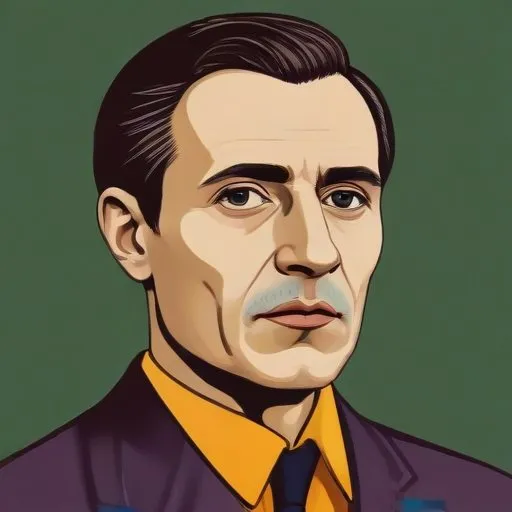
A renowned Latvian poet, journalist, and translator, celebrated for his lyrical poetry and literary translations that promoted cultural understanding. His works reflected the tumultuous era of Soviet occupation and Latvian independence.
Knuts Skujenieks, a Latvian poet, journalist, and translator, left an indelible mark on the world of literature with his profound and evocative works. As a master of linguistic expression, Skujenieks effortlessly traversed the realms of poetry, journalism, and translation, captivating audiences with his unique voice and perspective.
Born on September 5, 1936, in the picturesque region of Zemgale, near Bauska, Latvia, Skujenieks' early life was marked by a deep connection with nature and his cultural heritage. He drew inspiration from the rolling hills and rivers of his childhood surroundings, which would later shape his poetic vision.
Skujenieks' academic pursuits led him to the University of Latvia in Riga, where he honed his literary skills. He further refined his craft at the esteemed Maxim Gorky Literature Institute in Moscow, immersing himself in the works of great Russian writers.
In 1962, Skujenieks' life took a dramatic turn when he was convicted of anti-Soviet activities and sentenced to seven years in a prison camp in Mordovia, Russia. This period of confinement, though marked by hardship, became a transformative experience for the poet. The words he penned during his captivity would later be published, bearing testament to his unyielding spirit.
Skujenieks' poetry, though initially suppressed, eventually saw the light of day with the publication of his debut collection, Lirika un balsis (Lyrics and Voices), in 1978. This milestone marked the beginning of a prolific literary career, with subsequent collections, such as Iesien balt lakati (Tie it into a White Cloth) (1986) and Skla snieg (Seed in the Snow) (1990), cementing his reputation as a master poet.
Skujenieks' works have been translated into numerous European languages, earning him widespread recognition and acclaim. His poetry has been published in Sweden and Ukraine, further solidifying his status as a literary ambassador.
Skujeinkieks' contributions to literature were formally acknowledged when he was bestowed the prestigious Baltic Assembly Prize for Literature in 2008. This honor not only recognized his literary prowess but also served as a testament to his perseverance in the face of adversity.
In 2015, Film Director Ivars Tontegode embarked on a biographical documentary feature, KnutificationNepareizais, which delved into the fascinating life of Knuts Skujenieks. This cinematic tribute provided a unique window into the poet's experiences, further immortalizing his legacy.
Knuts Skujenieks' remarkable journey, marked by resilience, creativity, and a deep commitment to his art, continues to inspire generations of writers, poets, and scholars. His legacy serves as a beacon, illuminating the power of literature to transcend borders and touch the human heart.
As the world bid farewell to this extraordinary individual on July 25, 2022, we honor his memory by cherishing the wealth of words he left behind. Knuts Skujenieks' indelible mark on the world of literature will continue to reverberate, a testament to the transformative power of art and the resilience of the human spirit.
Born in 1865
A leading figure in Latvian literature, he's celebrated for his poetic and dramatic works that explored themes of national identity, social justice, and human emotion. His writings continue to inspire and influence Latvian culture to this day.
Born in 1903
A pioneering playwright who introduced modernist and expressionist elements to Latvian theatre, creating influential works that explored the human condition.
Born in 1907
A Latvian literary mastermind, celebrated for crafting vivid, psychologically nuanced novels and poetry that explored the human condition, often with a touch of magical realism.
93 Years Old
A prominent Latvian literary figure, celebrated for his contributions to the country's cultural heritage through his poetry and prose, which often explored themes of national identity and social commentary.
