


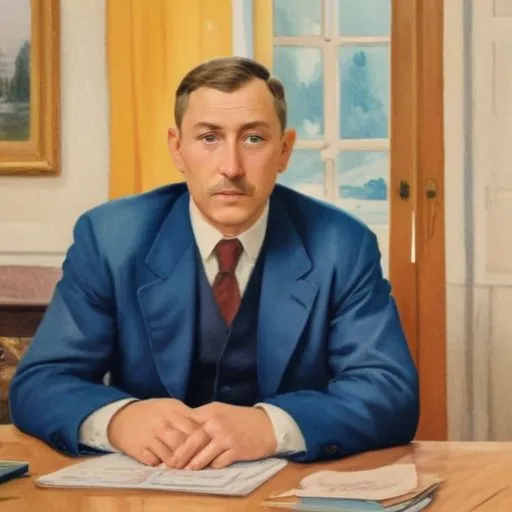
A Russian painter and set designer, renowned for his vibrant, dreamlike landscapes and theatrical designs that blended folk art and Symbolism. His work continues to inspire artists and designers today.
Konstantin Fyodorovich Yuon was a renowned Russian painter and theatre designer, celebrated for his Impressionist landscapes and Symbolist tendencies. As a key figure in the Mir Iskusstva movement, Yuon co-founded the Union of Russian Artists and the Association of Artists of Revolutionary Russia, leaving an indelible mark on the world of art and theatre.
Born on October 24, 1875, in Moscow, Yuon hailed from a Swiss-Russian family of banking clerks. His brother, Paul Juon, would later become a notable composer. Yuon's artistic journey began at the Moscow School of Painting, Sculpture, and Architecture, where he studied under the tutelage of Konstantin Savitsky and Konstantin Korovin from 1892 to 1898.
Following his graduation, Yuon received private lessons from the esteemed Valentin Serov between 1898 and 1900. This period of artistic growth was instrumental in shaping his unique style, which was further influenced by his travels to Western Europe, particularly Paris, where he was exposed to the cityscapes of Camille Pissarro and other Impressionists.
In 1900, Yuon established the first private painting and drawing school in Moscow, which attracted notable Russian painters, including Olga Zhekulina. He later taught at the Leningrad Academy of Arts and the Surikov Art Institute in Moscow, sharing his expertise with aspiring artists.
Yuon's foray into theatre design began with his work at the Moscow Art Theatre and the Maly Theater, where he eventually became the official designer from 1945 to 1947. His sets for plays and operas garnered critical acclaim, showcasing his versatility as an artist.
In the Soviet era, Yuon assumed the role of director at the Research Institute of the Academy of Arts from 1948 to 1950 and later became the First Secretary of the Union of Soviet Artists from 1956 to 1958. His contributions were recognized with a Stalin Prize in 1943, the Order of Lenin, and various other orders and medals.
Yuon's artistic repertoire boasts an impressive array of Impressionist landscapes, including "To the Trinity" (1903) and "Tverskoy Boulevard" (1909). His distinctive style, which blended Symbolist elements with Impressionist techniques, continues to inspire artists and art enthusiasts alike.
Konstantin Yuon's legacy extends beyond his remarkable body of work, as he played a pivotal role in shaping the Russian art scene through his teaching, theatre design, and leadership. His impact on modern art and theatre remains profound, solidifying his position as a Russian maestro.
Born in 1878
A Ukrainian painter and theorist who founded the Suprematist movement, creating geometric abstract works that explored the emotional and spiritual properties of color. They're most known for their iconic "Black Square" painting.
Born in 1866
A pioneer of abstract art, creating vibrant, expressive works that explored the emotional and spiritual properties of color, and wrote extensively on art theory.
Born in 1887
A dreamlike painter and poet who blended fantasy and reality, creating vibrant, emotive works that explored Jewish culture and the human experience.
Born in 1889
A pioneering Russian avant-garde artist and educator, known for her innovative and influential work in Cubism and Constructivism, blending art and technology. She played a significant role in shaping the Russian art scene in the early 20th century.
37 Years Old
A Ukrainian/Russian volleyball player who won multiple Olympic and World Championship medals, known for her exceptional blocking skills and dominance on the court.
