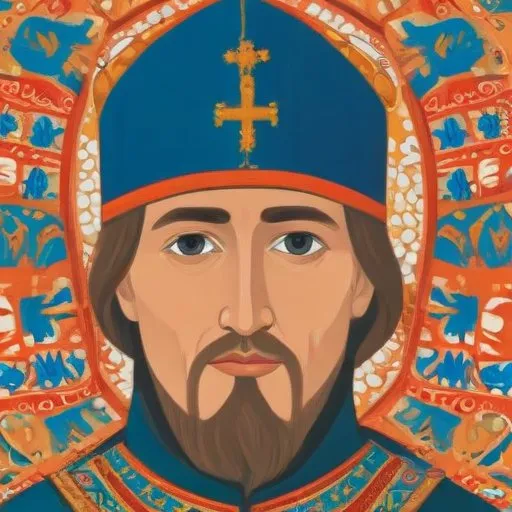
Konstantin of Rostov: The Builder of Cathedrals and a Legacy of Power
A Prince of Great Ambition and Vision
Konstantin of Rostov, the eldest son of Vsevolod the Big Nest, is remembered as a prince of great ambition and vision, who left an indelible mark on the city of Rostov and Yaroslavl. He is known for building the magnificent Assumption Cathedral in Rostov, a testament to his architectural legacy, and three brick cathedrals in Yaroslavl, cementing his position as a patron of the arts and a builder of grandeur.
Early Life and Struggles for Power
Born on May 18, 1186, Konstantin was destined for greatness, being the eldest son of the Grand Prince of Vladimir-Suzdal. However, his path to power was not without its challenges. In 1206 and 1207, he served as the prince of Novgorod, but was later appointed to rule over Rostov and Yaroslavl by his father.
A Family Feud and the Battle of Lipitsa
Upon his father's deathbed, Vsevolod disinherited Konstantin, bequeathing his capital Vladimir to his younger son, Yuri II. This led to a bitter struggle for power, culminating in the Battle of Lipitsa in 1216. Konstantin, aided by his ally Mstislav of Novgorod, emerged victorious, defeating Yuri and occupying Vladimir.
A Legacy of Architecture and Power
Konstantin's architectural legacy extends far beyond the Assumption Cathedral in Rostov. He commissioned three brick cathedrals in Yaroslavl, imbuing the city with a sense of grandeur and cultural sophistication. His reign was marked by a sense of urban renewal, as he sought to elevate the status of Rostov and Yaroslavl as centers of power and culture.
A Family Legacy and the Vladimir-Suzdal War of Succession
Konstantin's descendants retained control over Rostov and Yaroslavl until the late 15th century, establishing a dynasty of powerful princes who shaped the course of Russian history. The Vladimir-Suzdal War of Succession, sparked by Konstantin's struggle for power, lasted from 1212 to 1216 and involved various factions vying for control over the Vladimir-Suzdal principality.
Personal Milestones and Key Life Events
- 1186: Born on May 18
- 1206-1207: Served as prince of Novgorod
- 1207: Appointed to rule over Rostov and Yaroslavl by his father
- 1216: Defeated Yuri II in the Battle of Lipitsa and occupied Vladimir
- 1218: Died on February 2, marking the end of his reign
Historical Context and Legacy
Konstantin's life and reign were marked by a complex web of alliances, family feuds, and power struggles, characteristic of the medieval Russian principality. Despite the challenges he faced, he left an indelible mark on the cultural and architectural landscape of Rostov and Yaroslavl, cementing his position as a builder of grandeur and a prince of great vision.
FAQ
What is Konstantin of Rostovs role in Russian Orthodox Church history?
Konstantin of Rostov was a prince who played a significant role in Russian Orthodox Church history, particularly in the development of the Moscow Patriarchate.
How did Konstantin of Rostov contribute to the development of the Russian Orthodox Church?
Konstantin of Rostov contributed to the development of the Russian Orthodox Church by promoting the influence of the Moscow Patriarchate and supporting the growth of monasteries and Orthodox education.
What is Konstantin of Rostovs legacy in Russian politics?
Konstantin of Rostovs legacy in Russian politics is complex, with some viewing him as a hero who defended Russian interests and others criticizing him for his role in the development of the Moscow Patriarchate.
How has Konstantin of Rostov been remembered in Russian history?
Konstantin of Rostov has been remembered in Russian history as a key figure in the development of the Moscow Patriarchate and a defender of Russian Orthodox interests.
What are the main sources of information about Konstantin of Rostov?
The main sources of information about Konstantin of Rostov come from 16th-century Russian chronicles and historical accounts, which provide valuable insights into his life and legacy.