


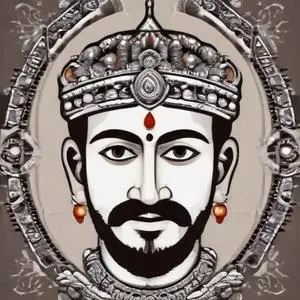
The emperor who ruled the Vijayanagara Empire in the 16th century, known for his military conquests, patronage of the arts, and architectural achievements, including the construction of temples and cities. He is also celebrated for his wise governance and cultural achievements.
Krishnadevaraya, one of the most revered rulers in Indian history, is renowned for his remarkable reign as the emperor of the Vijayanagara Empire from 1509 to 1529. During his tenure, he expanded and consolidated the empire, earning him the title of one of the greatest rulers in Indian history.
Born on January 17, 1471, Krishnadevaraya was the third monarch of the Tuluva dynasty. His early life is shrouded in mystery, but it is known that he rose to power through his military prowess and strategic alliances.
Krishnadevaraya's rule was marked by a series of military campaigns that expanded the Vijayanagara Empire. He defeated the sultans of Bijapur, Golconda, and the Bahmani Sultanate, and also subdued the rulers of Odisha and the Raichur doab. His military campaigns were often marked by sudden changes in battle plans, which caught his enemies off guard and turned the tide of battle in his favor.
Besides his military prowess, Krishnadevaraya was also an able administrator. He was known for his fairness and justice, and his court attracted scholars, poets, and musicians from all over the country. The Portuguese travellers Domingo Paes and Duarte Barbosa, who visited his court, praised his administrative skills and his ability to lead from the front in battle.
Krishnadevaraya earned several titles during his reign, including Andhra Bhoja, Karnatakaratna Simhasanadeeshwara, Yavana Rajya Pratistapanacharya, Kannada Rajya Rama Ramana, Gaubrahmana Pratipalaka, and Mooru Rayara Ganda. These titles reflect his status as a powerful ruler who commanded respect from his contemporaries.
Krishnadevaraya's legacy extends far beyond his military conquests and administrative prowess. He was a patron of the arts and literature, and his court saw the flourishing of Telugu literature and poetry. His rule also marked a period of cultural and religious tolerance, with Hindus, Muslims, and Christians living harmoniously in his empire.
In comparison to his contemporaries, Krishnadevaraya's achievements are all the more remarkable. The Mughal Emperor Babur, who was taking stock of the potentates of north India, rated Krishnadevaraya as the most powerful ruler in the subcontinent. This testifies to the esteem in which Krishnadevaraya was held by his contemporaries.
Despite his many achievements, Krishnadevaraya's personal life remains somewhat of a mystery. However, it is known that he was a devout Hindu and a patron of the temple at Tirupati. He was also known for his simplicity and humility, often attending to the wounded in battle himself.
Krishnadevaraya's philosophical contributions were shaped by his Hindu beliefs and his commitment to justice and fairness. His rule was guided by the principles of dharma and artha, which emphasized the importance of duty, morality, and prosperity.
Krishnadevaraya's reign marked the zenith of the Vijayanagara Empire, which was one of the largest empires in Indian history. His legacy continues to inspire Indians to this day, and he is remembered as an icon of Indian history and culture.
In conclusion, Krishnadevaraya's remarkable reign as the emperor of the Vijayanagara Empire continues to inspire awe and reverence. His military conquests, administrative skills, and cultural achievements make him one of the greatest rulers in Indian history. His legacy continues to shape Indian culture and identity to this day.
