


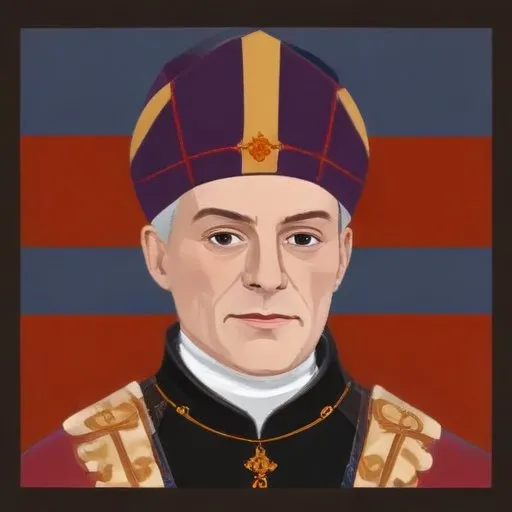
A 17th-century cleric who rose to prominence in the Church of England, known for his scandalous past as a pirate and his later efforts to reform the church.
Lancelot Blackburne, a 17th-century English clergyman, is famously known for his alleged pirating days before rising to become the Archbishop of York. This intriguing juxtaposition of pirate and priest has cemented his place in history, earning him the nickname "the jolly old Archbishop of York."
Born on December 10, 1658, in London, Blackburne was the younger brother of Richard Blackburne. He attended Westminster School and later entered Christ Church, Oxford, in 1676. After graduating in 1680, he was ordained a deacon in 1681 and traveled to the West Indies.
It is during this period that Blackburne's life takes a mysterious turn. Rumors abound that he spent these years sailing with buccaneers, either as their chaplain or as a pirate himself. Although there is little concrete evidence to support these claims, a record from 1681 shows that he received £20 (equivalent to £3,960 in 2023) from Charles II for "secret services."
Blackburne returned to England in 1684 and married Catherine Talbot, the elder sister of William Talbot, on September 2 at the Savoy Chapel. He shortly thereafter took up his first church post, marking the beginning of his rapid rise through the ecclesiastical ranks.
In 1691, he became a Canon of Exeter, and in 1705, he was appointed Dean of Exeter. He continued to climb the hierarchy, becoming Archdeacon of Cornwall in 1715 and Bishop of Exeter in 1717. His patron, William Wake, played a significant role in his career advancement.
In 1724, Blackburne reached the pinnacle of his ecclesiastical career when he was appointed Archbishop of York, a position he held until his death on March 23, 1743. As Archbishop, he became a Privy Counsellor and actively participated in the House of Lords.
Blackburne's life was marked by controversy, with many questioning the morality of a pirate-turned-clergyman. Horace Walpole, in his "Memoirs," described Blackburne as "the jolly old Archbishop of York, who had all the manners of a man of quality, though he had been a buccaneer, and was a clergyman; but he retained nothing of his first profession, except his seraglio."
Despite the controversy, Blackburne remains an intriguing figure in history, with his life serving as a testament to the complexities of human nature. His legacy continues to fascinate, inspiring numerous works of fiction and art over the centuries.
Blackburne's life serves as a reminder that even the most unlikely individuals can achieve greatness, despite their past transgressions. His legacy continues to captivate, inspiring generations to come.
Born in 1899
Early Hollywood leading man, known for his dashing good looks and romantic roles in silent films, particularly in the 1920s.
Born in 1899
Early Hollywood leading man, known for his dashing good looks and romantic roles in silent films, particularly in the 1920s.
