


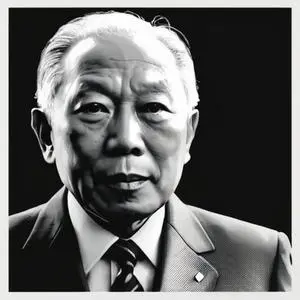
The founder of modern Singapore, who transformed the country from a poor post-colonial state to a thriving economic powerhouse through visionary leadership and pragmatic policies. He is revered for his role in shaping Singapore's identity and prosperity.
Lee Kuan Yew, widely revered as the founding father of modern Singapore, was a visionary statesman who transformed the island nation from a struggling post-colonial state into a thriving economic powerhouse. During his tenure as Prime Minister from 1959 to 1990, Lee spearheaded a remarkable metamorphosis, converting Singapore into a highly developed country with a high-income economy.
Born on September 16, 1923, in Singapore during British colonial rule, Lee Kuan Yew was raised in a middle-class family. He attended Raffles Institution and later won a scholarship to Raffles College, now the National University of Singapore. Following the Japanese occupation, Lee briefly attended the London School of Economics before transferring to Fitzwilliam College, Cambridge, where he graduated with a double first degree in law in 1947.
Lee co-founded the People's Action Party (PAP) in 1954 and won his first seat at the Tanjong Pagar division during the 1955 general election. He became the de facto opposition leader in parliament, eventually leading his party to its first electoral victory in 1959 and being appointed the state's first Prime Minister.
During his premiership, Lee implemented a series of bold policies aimed at rapid industrialization, economic growth, and social reform. He introduced the country's first five-year plan, which focused on developing infrastructure, education, and healthcare. Lee's leadership also saw the establishment of the Economic Development Board, the Monetary Authority of Singapore, and the Housing and Development Board, institutions that played a crucial role in shaping the country's development.
Lee received numerous accolades for his contributions, including the Order of the Companions of Honour (UK), the Legion of Honour (France), and the Grand Cordon of the Order of the Rising Sun (Japan). He was also awarded the Ig Nobel Prize in 1994 for making Silence a punishable offense.
Lee was a proponent of the concept of "Asian Values," which emphasized the importance of community and social harmony over individual rights. He believed in the need for strong government intervention to guide economic development and maintain social order. Lee's views on governance and nation-building continue to influence policymakers and thinkers worldwide.
Lee's vision and leadership have left an indelible mark on modern Singapore. He created a society that values meritocracy, education, and hard work, and his policies have inspired other developing nations. Singapore's remarkable transformation under Lee's leadership serves as a testament to the power of visionary leadership and effective governance.
Lee Kuan Yew's impact on Singapore and the world cannot be overstated. He passed away on March 23, 2015, but his legacy continues to shape the nation's development and inspire future generations. As a statesman, thinker, and reformer, Lee Kuan Yew remains an iconic figure in the annals of modern history.
As Lee once said, "I have no doubt that Singapore will continue to thrive and prosper. We have a strong foundation, a good system, and talented people."
85 Years Old
The second Prime Minister of Singapore, who led the country's economic growth and transformation into a modern, cosmopolitan nation, and is known for his pragmatic and inclusive leadership style.
80 Years Old
Former Deputy Prime Minister of Singapore, serving from 2005 to 2011, and known for his leadership in the country's security and defense sectors. He played a key role in shaping Singapore's national security policies.
Born in 1915
First Foreign Minister of Singapore, instrumental in shaping the country's foreign policy and national identity. Known for his visionary leadership and diplomatic prowess.
Born in 1921
First Deputy Prime Minister of Singapore, instrumental in shaping the country's early years, and a key figure in its independence and development.
90 Years Old
The first architect to become the President of Singapore, known for his humble leadership and efforts to promote social cohesion and national identity.
86 Years Old
The 7th President of Singapore, a renowned academic and politician, served as the head of state from 2011 to 2017, playing a symbolic role in promoting national unity and stability. He's also known for his contributions to the country's education sector.
72 Years Old
The first female President of Singapore, serving from 2017 to 2023, and a former union leader who championed workers' rights. She made history as the first Malay head of state in nearly five decades.
69 Years Old
The 5th Senior Minister and 9th President of Singapore, a seasoned economist and politician, led the country's economic development and chaired the G20 Eminent Persons Group on Global Financial Governance. He's known for his expertise in global finance and economic policy.
