


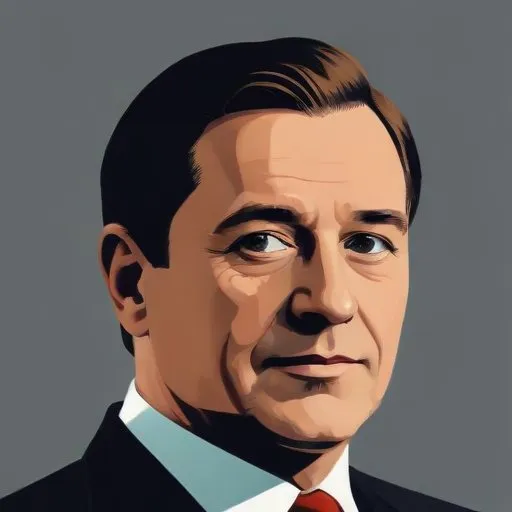
The 43rd Prime Minister of Belgium, serving from 1974 to 1978, known for his efforts to reform the Belgian state and his role in shaping the European Union. He was a key figure in Belgian and European politics during the 1970s and 1980s.
Leo Tindemans, a Belgian politician, is renowned for his pivotal role in shaping the European Union as we know it today. As the Prime Minister of Belgium from 1974 to 1978, he played a crucial part in defining the contours of European integration, earning him the esteemed Charlemagne Prize in 1976.
Born on April 16, 1922, in Zwijndrecht, Belgium, to a Catholic family, Tindemans was affiliated with the Christian Democratic and Flemish party (CVP). He began his political career in 1961, when he was elected to the Belgian Chamber of Representatives, and re-elected in 1965, 1968, 1971, 1974, 1977, and 1978.
In addition to his parliamentary duties, Tindemans served as the mayor of Edegem from 1965 to 1973. During this period, he also held various ministerial positions, including minister tasked with community relations (1968-1972), minister for agriculture (1972-1973), and deputy Prime Minister and minister for the budget (1973-1974).
At the Paris Summit in 1974, Tindemans was entrusted with the task of defining the concept of European Union. The resulting Tindemans Report, submitted in 1975, provided a comprehensive blueprint for European integration, encompassing economic, political, and social aspects.
The report's significance lies in its acknowledgment of the need for a more cohesive European entity, with a common market, a single currency, and a united foreign policy. Tindemans' vision for a unified Europe has since influenced the development of the European Union, shaping its institutions, policies, and goals.
Tindemans' tenure as Prime Minister of Belgium spanned two governments, from 1974 to 1978. During this period, he successfully navigated the complexities of coalition politics, forging alliances with the liberals, socialists, and Flemish nationalists.
His second government (1977-1978) fell due to the controversy surrounding the Egmont Pact, a constitutional reform aimed at devolving power to the regions. Despite this setback, Tindemans' contribution to European integration and his commitment to the European project have left an indelible mark on Belgian and European politics.
In recognition of his outstanding services to European unity, Tindemans was awarded the Charlemagne Prize in 1976. This prestigious award honors individuals who have made significant contributions to the process of European integration and unity.
Leo Tindemans passed away on December 26, 2014, leaving behind a legacy of commitment to European integration, democracy, and unity. His work continues to inspire generations of politicians, scholars, and citizens, shaping the course of European history.
87 Years Old
A Belgian maestro who led NATO as its 8th Secretary General, known for his diplomatic efforts to strengthen European security and defense. He also conducted several orchestras, blending music with politics.
86 Years Old
A French-Belgian lawyer and politician who served as the 63rd Prime Minister of Belgium, known for his key role in shaping the European Union and its institutions. He was a strong advocate for European integration and played a crucial part in the creation of the euro currency.
73 Years Old
The 47th Prime Minister of Belgium, a prominent liberal politician who played a key role in shaping the European Union's policies and architecture. He's a strong advocate for a federal Europe and has been a vocal critic of nationalism.
78 Years Old
The first permanent President of the European Council, known for his role in shaping the European Union's economic and political policies. A key figure in European politics, guiding the EU through the European sovereign-debt crisis.
75 Years Old
A Belgian chemist-turned-politician who served as Prime Minister of Belgium, known for his efforts to stabilize the country's economy and politics during a period of crisis.
Born in 1863
A German nobleman who ruled Mecklenburg from 1785 to 1837, known for his progressive reforms and cultural achievements.
Born in 1919
A Belgian businessman and politician who served as the 55th Prime Minister of Belgium, known for his controversial political career and alleged involvement in the Dutroux affair.
