


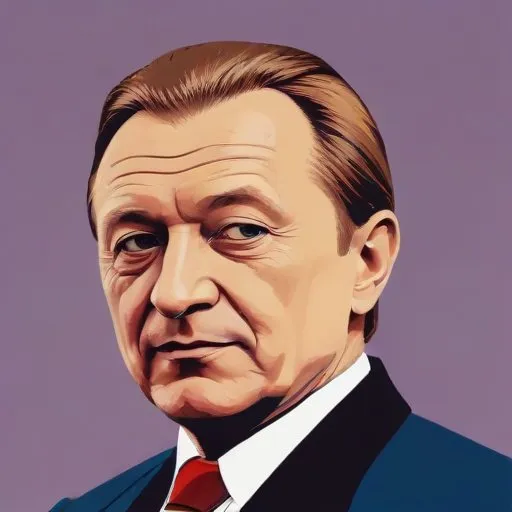
Ukraine's second president, an engineer-turned-politician, known for navigating the country's post-Soviet transition and implementing economic reforms. He's also infamous for his alleged role in a journalist's murder.
Leonid Kuchma, a Ukrainian politician, served as the second President of Ukraine from 1994 to 2005, marking a period of significant transformation in the country's political and economic landscape. He is notably the only President of Ukraine to have served two terms, leaving a lasting impact on the nation's history.
Born on August 9, 1938, Kuchma began his career in the machine-building industry of the Soviet Union. He later transitioned to politics, getting elected to the Verkhovna Rada (Ukrainian parliament) in 1990 and re-elected in 1994.
Kuchma's political career gained momentum when he served as Prime Minister of Ukraine between October 1992 and September 1993. His popularity led to his victory in the 1994 presidential election, defeating incumbent President Leonid Kravchuk. He secured re-election for an additional five-year term in 1999.
Kuchma's presidency was marred by allegations of corruption, media censorship, and scandals. The Ukrainian economy declined initially, but growth was recorded from 2000 onwards, bringing relative prosperity to some segments of urban residents. Notably, Ukrainian-Russian ties improved during his presidency.
In 1999, Kuchma's administration began a campaign of media censorship, leading to the arrests of journalists and the eventual death of Georgiy Gongadze. This sparked mass protests and widespread condemnation.
Kuchma's legacy is complex, with both positive and negative aspects. While he oversaw the growth of the Ukrainian economy and improved relations with Russia, his presidency was tainted by allegations of corruption and democratic backsliding.
Kuchma declined to seek a third term in office and instead supported Party of Regions candidate Viktor Yanukovych for the 2004 election. Following public protests over alleged electoral fraud, which escalated into the Orange Revolution, Kuchma took a neutral stance and was a mediator between Viktor Yushchenko and Viktor Yanukovych. Between 2014 and 2020, Kuchma served as a special presidential representative of Ukraine at the quasi-peace talks regarding the ongoing War in Donbas.
Kuchma's personal life has been relatively private, with little information available about his family or personal relationships.
Kuchma's philosophical beliefs and contributions are largely undefined, with his presidency marked by practical decision-making rather than ideological conviction.
Kuchma's presidency had a significant impact on modern Ukrainian society, shaping the country's political and economic trajectory. His legacy continues to influence Ukrainian politics and international relations.
Despite his complex and controversial legacy, Leonid Kuchma remains a significant figure in Ukrainian history, with his presidency leaving an indelible mark on the nation's development.
92 Years Old
The first president of Ukraine, serving from 1991 to 1994, known for leading the country to independence from the Soviet Union. He played a crucial role in shaping Ukraine's early years as a sovereign state.
72 Years Old
Ukraine's 3rd President, a key figure in the country's Orange Revolution, known for his pro-democracy stance and surviving a poisoning attempt.
65 Years Old
A Ukrainian economist and politician who served as Prime Minister of Ukraine, known for her key role in the Orange Revolution and her advocacy for Ukrainian independence and democracy.
76 Years Old
A Ukrainian engineer-turned-politician who served as President of Ukraine from 2010 to 2014, known for his pro-Russian stance and fleeing the country amidst protests.
61 Years Old
A Ukrainian billionaire and politician who served as the President of Ukraine from 2014 to 2019, known for his efforts to integrate Ukraine with the European Union and his role in the Ukrainian crisis.
52 Years Old
Ukraine's former Prime Minister, known for navigating the country through a tumultuous period of revolution and conflict with Russia. He played a crucial role in shaping Ukraine's modern political landscape.
