


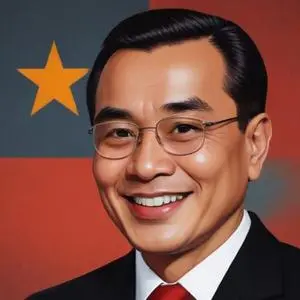
The 7th Premier of the People's Republic of China, serving from 2013 to 2023, oversaw China's economic reforms and played a key role in shaping the country's global influence. He implemented policies to boost domestic consumption and reduce reliance on exports.
Li Keqiang, a renowned Chinese economist and politician, served as the premier of China from 2013 to 2023, and was the second-ranked member of the Politburo Standing Committee of the Chinese Communist Party (CCP) from 2012 to 2022. He is known for his efforts to shift China's economic focus from export-led growth to a greater emphasis on internal consumption, and for promoting economic reform and liberalization.
Born on July 3, 1955, in Hefei, Anhui province, Li Keqiang rose through the ranks of Chinese politics through his involvement in the Communist Youth League of China (CYLC). He served as the first secretary of the CYLC from 1993 to 1998, and later as the governor of Henan and the province's party secretary from 1998 to 2004.
From 2004 to 2007, Li served as the party secretary of Liaoning, the top political office in the province. He then served as the first-ranked vice premier under then-premier Wen Jiabao from 2008 to 2013, overseeing a broad portfolio that included economic development, price controls, finance, climate change, and macroeconomic management.
As premier, Li facilitated the Chinese government's shift in priorities from export-led growth to a greater focus on internal consumption. He also headed the State Council and was one of the leading figures behind China's Financial and Economic Affairs, Foreign Affairs, National Security, and Deepening Reforms. In May 2015, Li and his cabinet initiated the Made in China 2025 strategic plan, aimed at transforming China into a high-tech manufacturing powerhouse.
Li Keqiang is generally considered a political ally of former leader Hu Jintao and a member of the Tuanpai faction. He is economically seen as advocating reform and liberalization, and has been described as representing the more pragmatic and technocratic side of China's leadership.
Li Keqiang stepped down from the Politburo Standing Committee in October 2022 and was succeeded as premier by Li Qiang. During his tenure, he oversaw significant economic development and growth in China.
Despite his efforts to promote economic reform, Li's tenure was not without controversy. He faced criticism for his handling of various issues, including China's economic slowdown and the government's response to the COVID-19 pandemic.
Li Keqiang's legacy is marked by his commitment to economic reform and liberalization, and his efforts to shift China's economic focus towards internal consumption. His tenure as premier will be remembered as a period of significant change and growth in China.
Li Keqiang's tenure as premier marked a significant shift in China's economic development, as the country moved away from export-led growth and towards a more consumer-driven economy. His leadership style and policies have been compared to those of his predecessors, including Hu Jintao and Wen Jiabao.
Li Keqiang has received numerous awards and honors for his contributions to Chinese politics and economics, including the Order of the Golden Arrows of the Chinese Communist Party.
Li Keqiang's leadership style and policies have been referenced and parodied in various forms of Chinese media, including films, television shows, and social media.
Li Keqiang has been involved in various charitable initiatives, including poverty alleviation programs and education initiatives, during his tenure as premier.
Li Keqiang's rise to prominence is an inspiration to many young Chinese, who see him as a symbol of the country's economic and political progress.
As Li Keqiang steps down from his role as premier, many are speculating about his future role in Chinese politics and his potential legacy in the years to come.
73 Years Old
The supreme leader of China, overseeing the country's rapid economic growth and asserting its global influence, while consolidating power and cracking down on dissent.
83 Years Old
The 5th Paramount leader of China, who served from 2002 to 2012, is known for his role in China's rapid economic growth and his "Scientific Development Concept" policy. He also increased China's global influence through strategic diplomacy.
