


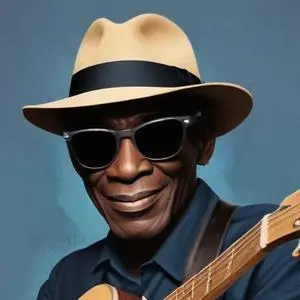
A Texas-born blues legend, known for his soulful, improvisational style and poignant storytelling through music, capturing the essence of African-American life in the rural South.
Known for his soulful, poetic lyrics and distinctive guitar playing style, Lightnin Hopkins is revered as one of the most influential country blues singers of all time. Ranked No. 71 on Rolling Stone's list of the 100 greatest guitarists of all time, Hopkins' music has had a profound impact on generations of blues musicians.
Born Samuel John Hopkins on March 15, 1912, in Centerville, Texas, Hopkins was exposed to the blues from a young age. He developed a deep appreciation for the music at the age of eight, when he met Blind Lemon Jefferson at a church picnic in Buffalo, Texas. This chance encounter had a profound influence on Hopkins, who went on to learn from his distant older cousin, the country blues singer Alger Texas Alexander.
Hopkins' musical career was marked by periods of incarceration and struggles to break into the music scene. In the mid-1930s, he was sent to Houston County Prison Farm, although the reason for his imprisonment remains unknown. Despite these setbacks, Hopkins persevered, eventually moving to Houston in the late 1930s with Alexander in an attempt to launch his music career.
In 1946, Hopkins took a second shot at Houston, singing on Dowling Street in the city's Third Ward. It was here that he was discovered by Lola Anne Cullum of Aladdin Records, who convinced him to travel to Los Angeles to record. This marked the beginning of Hopkins' successful music career, during which he accompanied pianist Wilson Smith and went on to record numerous albums.
Hopkins' music has had a profound impact on modern society, influencing generations of blues musicians, including Townes Van Zandt, Hank Williams Jr., and Stevie Ray Vaughan. His song "Hopkins Sky Hop" directly inspired Vaughan's Grammy-winning song "Rude Mood". Hopkins' unique style, which blended jazz and poetry, has been praised by musicologists and critics alike.
Hopkins' legacy continues to be felt in the music world today. His unique style, which blended jazz and poetry, has inspired generations of musicians. As the musicologist Robert Mack McCormick opined, Hopkins embodies the jazz and poetry spirit, representing its ancient form in the single creator whose words and music are one act.
Born in 1913
A blues legend who electrified the genre with his signature sound and influential hits like "Hoochie Coochie Man" and "Mannish Boy", shaping the course of rock 'n' roll .
Born in 1925
A legendary blues musician renowned for his soulful voice, masterful guitar playing, and iconic hits like "The Thrill Is Gone." He's the embodiment of blues music, inspiring countless artists across genres.
Born in 1917
A legendary blues musician who mesmerized audiences with his unique, boogie-woogie guitar style and soulful vocals, creating a distinctive sound that influenced many rock and roll artists.
Born in 1910
A blues legend who electrified audiences with his powerful voice and guitar playing, creating a unique sound that influenced many rock and roll artists.
Born in 1902
A pioneering Delta blues musician, known for his powerful, emotive voice and intricate guitar playing, which heavily influenced later blues and rock artists.
Born in 1911
Legendary blues musician and songwriter who sold his soul to the devil at a crossroads in exchange for mastery of the guitar, creating iconic delta blues classics.
Born in 1903
A pioneering Delta blues musician, known for his distinctive, rough-edged voice and guitar playing, influencing many later blues and rock artists.
Born in 1914
A pioneering blues musician, he's renowned for his soulful harmonica playing and influential songwriting, which shaped the Chicago blues sound.
