


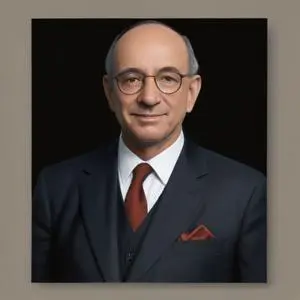
Developed game theory models that help us understand how people make decisions when outcomes depend on multiple parties, and was awarded the Nobel Prize in Economics for his work on stable allocations. His theories have far-reaching applications in fields like economics, politics, and biology.
Lloyd Shapley, a renowned American mathematician and economist, is best known for his groundbreaking contributions to the field of game theory, earning him the 2012 Nobel Memorial Prize in Economic Sciences.
Shapley's work, particularly his theory of stable allocations and market design, has had a profound impact on understanding conflict and cooperation, making him one of the most important contributors to game theory since the work of von Neumann and Morgenstern.
Born on June 2, 1923, in Cambridge, Massachusetts, Shapley was the son of astronomers Harlow and Martha Betz Shapley.
He attended Phillips Exeter Academy and later enrolled at Harvard University, where he was drafted into the United States Army Air Corps in 1943.
During his time in the Army, Shapley served in Chengdu, China, and received the Bronze Star decoration for breaking the Soviet weather code.
After the war, Shapley returned to Harvard, graduating with an A.B. in mathematics in 1948.
Shapley's work at the RAND Corporation and Princeton University laid the foundation for his seminal contributions to game theory.
In 1953, he received his Ph.D. from Princeton University, based on his thesis "Additive and nonadditive set functions," which introduced the Shapley value and the core solution in game theory.
Shapley's work defined game theory as a mathematical study of conflict and cooperation, and his theories have been widely applied in economics, politics, and social sciences.
One of his most notable contributions is the invention of the board game "So Long Sucker," created along with Mel Hausner, John Forbes Nash, and Martin Shubik in 1950.
Shapley's work was recognized with numerous awards and honors, including:
Lloyd Shapley's work has had a lasting impact on the field of game theory, and his theories continue to influence modern economics, politics, and social sciences.
As a testament to his contributions, Israeli economist and Nobel Laureate Robert Aumann considered Shapley to be the greatest game theorist of all time.
Shapley's legacy extends beyond his academic work, inspiring generations of scholars and researchers to explore the intricacies of human conflict and cooperation.
Shapley served as a professor at the University of California, Los Angeles (UCLA) from 1981 until his death in 2016, and was affiliated with the Mathematics and Economics departments.
Throughout his life, Shapley remained dedicated to his work, leaving behind a legacy that continues to shape our understanding of human behavior and decision-making.
Born in 1752
Designed grand, neoclassical buildings in England, including the Royal Pavilion and Buckingham Palace, revolutionizing British architecture with his Regency style.
Born in 1920
A pioneering biologist who applied game theory to evolution, shedding light on the strategic nature of natural selection and its role in shaping species' traits.
96 Years Old
A renowned mathematician and economist who pioneered game theory, shedding light on human decision-making and conflict resolution, earning a Nobel Prize in Economics.
Born in 1921
A Nobel Prize-winning economist who developed game theory to understand conflict and cooperation, and applied it to issues like nuclear deterrence and climate change.
92 Years Old
A pioneering economist who challenged traditional theories by showing how communities can successfully manage shared resources, leading to a Nobel Prize in Economics in 2009.
72 Years Old
A French economist and academic who won the Nobel Prize for his work on market power and regulation, particularly in the fields of industrial organization and behavioral economics.
