


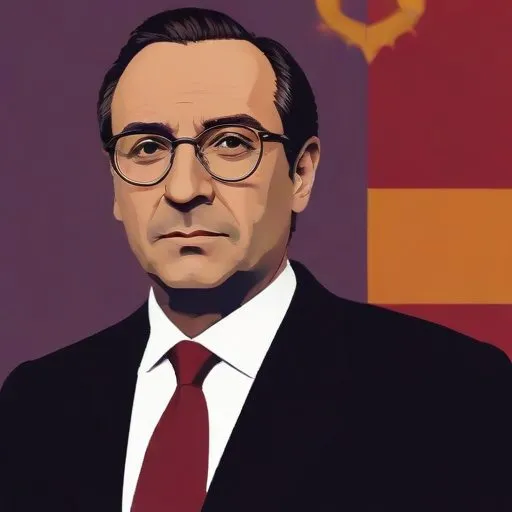
The 123rd President of Catalonia was a Spanish lawyer and politician who fought for Catalan autonomy and independence, ultimately facing execution by fascist forces in 1940. He's a symbol of Catalan resistance and national identity.
Llus Companys i Jover, a prominent Catalan politician, served as the president of Catalonia from 1934 and played a pivotal role during the Spanish Civil War. He was a passionate advocate for Catalan self-governance and a leading figure of the Republican Left of Catalonia (ERC) political party.
Companys was born on June 21, 1882, in El Tarrs, into a peasant family with aristocratic roots. He was the second child of ten, and his parents, Josep Companys and Maria Llusa de Jover, sent him to study at the boarding school of Liceu Poliglot in Barcelona.
He later obtained his degree in law from the University of Barcelona, where he met Francesc Layret, a fellow Catalan nationalist and politician. This marked the beginning of his involvement in the political life of Catalonia, which would eventually lead him to become a key figure in the country's struggle for independence.
Companys' political career gained momentum in 1906, following the military attack on the offices of Catalan newspapers CuCut and La Veu de Catalunya. He actively participated in the protests against the Ley de Jurisdicciones (Law of Jurisdictions), which criminalized speech against Spain and its symbols.
In 1931, he co-founded the Republican Left of Catalonia (ERC) party, which became a powerful platform for Catalan nationalism. As one of the party's most prominent leaders, Companys worked tirelessly to promote Catalan autonomy and self-governance.
In 1934, Companys was appointed president of the Generalitat of Catalonia, following the death of Francesc Macià. During his presidency, he implemented a progressive agenda, focusing on consolidating Catalan self-governance and social reform.
However, his presidency was marked by turmoil, as he faced opposition from the central Spanish government. In 1934, he proclaimed a new Catalan State, which led to his imprisonment between 1934 and 1936.
Despite these challenges, Companys remained a strong advocate for Catalan independence and played a crucial role during the Spanish Civil War. He remained loyal to the Republican faction and continued to lead the Catalan government in exile, even after the war.
In 1939, Companys fled to France, where he was captured by the Gestapo, the secret police of Nazi Germany, in 1940. He was handed over to the Spanish State of Francisco Franco, which led to his execution by firing squad on October 15, 1940.
Llus Companys' bravery and unwavering commitment to Catalan independence have made him a national hero in Catalonia. His legacy continues to inspire generations of Catalans fighting for self-determination and autonomy.
Today, Companys is remembered as a symbol of Catalan resistance against oppression, and his story serves as a powerful reminder of the importance of fighting for one's beliefs, even in the face of adversity.
Born in 1859
A Catalan colonel and politician who served as the 122nd President of Catalonia, known for leading the region's government during a tumultuous period of Spanish history. He played a key role in Catalonia's struggle for autonomy.
