


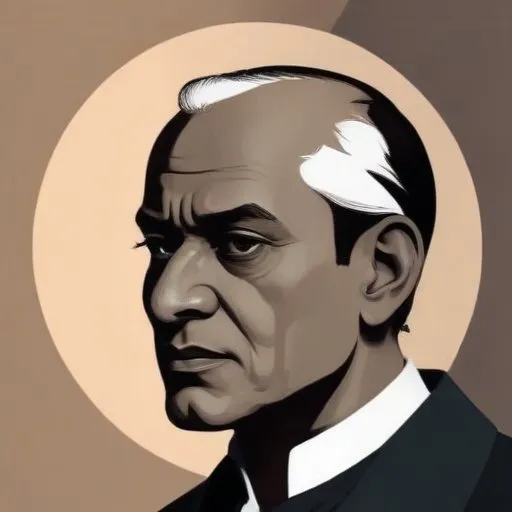
A renowned Indologist and scholar of Buddhism, he deciphered and translated ancient scripts, contributing significantly to the understanding of Indian and Tibetan cultures.
Lokesh Chandra is a towering figure in the realm of Indian scholarship, renowned for his extensive contributions to the fields of Vedic period, Buddhism, and Indian arts. With an astonishing 576 books and 286 articles to his credit, his prolific output has left an indelible mark on the academic landscape.
Born on April 11, 1927, in Ambala, India, Lokesh Chandra was destined for greatness. As the son of the illustrious Sanskrit scholar, linguist, and politician Raghu Vira, he was immersed in a world of learning from a young age. After completing his master's degree from the University of the Punjab in Lahore in 1947, Chandra embarked on a journey to the Netherlands, where he studied Old Javanese with the esteemed Indologist Jan Gonda at Utrecht University.
Chandra's dissertation, "Jaiminiya Brahmana of the Samaveda II.180," earned him a Ph.D. in 1950. This marked the beginning of a long and illustrious career, during which he would delve into the depths of Indian culture, history, and philosophy, emerging with a treasure trove of knowledge that would enrich generations to come.
Lokesh Chandra's contributions to the world of scholarship are staggering. His magnum opus, the 15-volume "Dictionary of Buddhist Art," is a testament to his erudition and dedication. Other notable works include his "Tibetan-Sanskrit Dictionary," "Materials for a History of Tibetan Literature," and "Buddhist Iconography of Tibet." These classics have become benchmarks for scholars and researchers in the field.
In addition to his academic pursuits, Chandra has held various official positions in the Indian government, leveraging his expertise to shape policy and promote cultural understanding. He has been a member of the Indian Parliament twice, serving from 1974-1980 and 1980-1986, and has also held positions on committees related to education, official language, tourism, and heavy industry, among others.
Lokesh Chandra's contributions have been recognized and celebrated through various awards and honors. In 2006, he was conferred with the Padma Bhushan, one of India's highest civilian honors. He has also served as the president of the Indian Council for Cultural Relations (2014-2017) and has been a member of the Indian Rajya Sabha, vice-president of the Indian Council for Cultural Relations, and Chairman of the Indian Council of Historical Research.
Lokesh Chandra's impact on Indian culture and scholarship is immeasurable. His works have not only shed light on the rich cultural heritage of India but have also inspired generations of scholars, researchers, and thinkers. As a titan of Indian scholarship, his legacy will continue to inspire and enlighten, a beacon of knowledge and wisdom in an increasingly complex world.
In paying tribute to Lokesh Chandra, we honor not only his remarkable achievements but also his unwavering commitment to the pursuit of knowledge and his tireless efforts to promote cultural understanding. His life's work is a testament to the power of human curiosity and the boundless potential of the human mind.
By delving into the life and works of Lokesh Chandra, we come to appreciate the significance of his contributions and the enduring impact he has had on Indian culture and scholarship. His legacy will continue to inspire and enlighten, a shining beacon of knowledge and wisdom for generations to come.
