


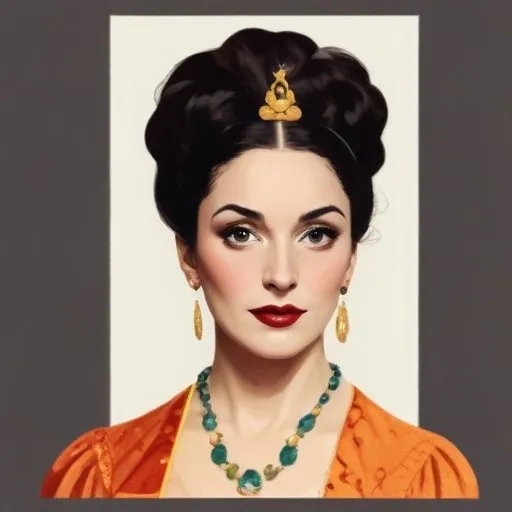
A 19th-century beauty and performer who captivated audiences with her exotic dance moves and scandalous personal life, becoming a muse to King Ludwig I of Bavaria.
Lola Montez, the enigmatic Irish dancer and actress, was the toast of Europe's royal courts in the 19th century. She mesmerized audiences with her sultry Spanish dances, bewitched kings with her captivating charm, and left a lasting legacy that still fascinates historians and enthusiasts alike.
Born Eliza Rosanna Gilbert on February 17, 1821, in Grange, County Sligo, Ireland, Lola Montez was destined for a life of drama and spectacle. Her Anglo-Irish family's military connections took them to India, where she received a convent education and developed her love for dance.
In the 1840s, Montez invented a fictional Spanish identity for herself, adopting the name Lola Montez and claiming to be a noble Andalusian dancer. This ruse catapulted her to fame in Europe, where she performed for royalty, including King Ludwig I of Bavaria. The Bavarian king was so enamored with Montez that he bestowed upon her the title of Countess of Landsfeld.
As the Revolutions of 1848 swept across Europe, Montez found herself at the center of a maelstrom. Her association with the Bavarian monarch made her a target for revolutionaries, forcing her to flee to Austria, Switzerland, France, and eventually, the United States.
In America, Montez reinvented herself as a lecturer on topics ranging from literature to politics. Her lectures, which often featured dramatic readings and musical performances, captivated audiences and earned her a reputation as a charismatic orator.
Lola Montez's life was marked by scandal and controversy. Her numerous love affairs, including rumored trysts with luminaries like Franz Liszt and Alexandre Dumas, kept the gossip mills churning. Her tempestuous relationships with powerful men often ended in dramatic fashion, earning her a reputation as a femme fatale.
Despite the controversies, Montez's impact on the world of dance and entertainment cannot be overstated. She popularized the Spanish dance style, inspiring a new generation of performers. Her pioneering work as a female lecturer and writer paved the way for future generations of women in the arts.
"I am an actress, a dancer, a courtesan, and a countess. I am a woman of the world, and I have lived a life of passion and excitement."
"Women are not inferior to men. They are merely differently constituted. They have their own sphere, their own duties, and their own rights."
Lola Montez's life was a testament to the power of reinvention and self-creation. Her remarkable story has inspired generations of artists, performers, and women's rights advocates. As a cultural icon of the 19th century, Montez continues to captivate audiences with her daring spirit, her unapologetic sensuality, and her unwavering commitment to living life on her own terms.
Born in 1811
A virtuosic pianist and composer who revolutionized classical music with his technically demanding and emotionally expressive works, blending Hungarian folk influences with Romantic-era drama.
Born in 1802
Wrote iconic adventure novels like "The Count of Monte Cristo" and "The Three Musketeers", creating unforgettable characters and stories that have stood the test of time.
Born in 1799
A prolific writer who created a vast array of characters and stories that explored the human condition, particularly in the context of post-Napoleonic France. His works are considered a cornerstone of French literature.
Born in 1792
Operatic mastermind behind iconic comedies like "The Barber of Seville" and "William Tell," crafting catchy, witty, and playful music that still delights audiences today.
Born in 1798
A Romantic-era master of expressive brushstrokes and vivid color, creating iconic works that captured the drama and emotion of historical and literary scenes.
Born in 1791
A Romantic-era master of dramatic and emotionally charged art, known for his powerful depictions of horses and the human experience.
Born in 1833
A renowned pianist and composer, he crafted complex, expressive works that blended traditional and innovative techniques, leaving an indelible mark on classical music.
