


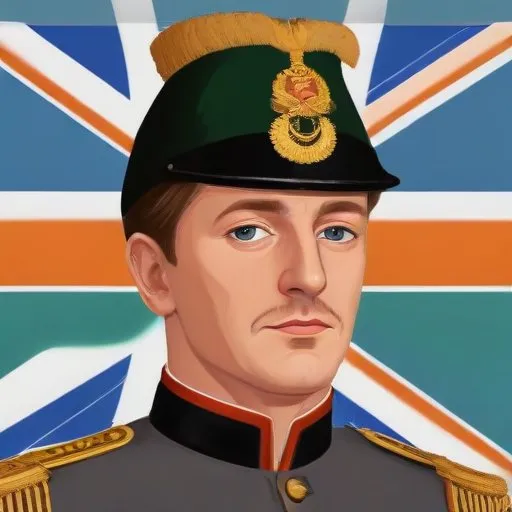
Anglo-Irish soldier and politician who served as Chief Secretary for Ireland, assassinated in Dublin's Phoenix Park in 1882, sparking outrage and reform. He's most known for his tragic death and its impact on Irish politics.
Lord Frederick Cavendish was a British Liberal politician who rose to prominence as Chief Secretary for Ireland, only to meet a tragic end in the Phoenix Park Murders. This pivotal event in Irish history would forever etch his name in the annals of politics and tragedy.
Born on November 30, 1836, at Compton Place, Eastbourne, Sussex, Cavendish was the second son of the 7th Duke of Devonshire and Lady Blanche Howard. His brother, the Marquess of Hartington, would later become the 8th Duke of Devonshire. Cavendish received his education at Trinity College, Cambridge, graduating with a B.A. in 1858. He also served as a cornet with the Duke of Lancaster's Own Yeomanry cavalry.
Cavendish's political career began in 1859 as private secretary to Lord Granville. He later traveled to the United States and Spain, broadening his horizons and gaining valuable experience. In 1865, he was elected to the House of Commons as a Liberal for the Northern Division of the West Riding of Yorkshire, a position he held until his death.
On May 6, 1882, Cavendish, along with Thomas Henry Burke, was assassinated in the Phoenix Park, Dublin, by the Irish National Invincibles. This brutal act of violence occurred just hours after his arrival in Dublin, marking a devastating blow to the British government and Irish politics.
Lord Frederick Cavendish's tragic demise sent shockwaves throughout the British Empire, leaving an indelible mark on Irish history. His legacy serves as a poignant reminder of the complex and tumultuous nature of Irish politics during the late 19th century.
"The policy of the Government is to govern Ireland according to the principles of justice and equality." - Lord Frederick Cavendish
Lord Frederick Cavendish's life and death are inextricably linked to the complex web of Irish politics during the late 19th century. His tragic fate serves as a testament to the sacrifices made by those who dared to shape the course of history.
Born in 1846
Leader of the Irish Parliamentary Party, advocating for Irish Home Rule and land reform, known for his charismatic leadership and strategic political maneuvering.
Born in 1804
A skilled politician who served as Prime Minister of the United Kingdom, known for his influential role in shaping the country's politics and economy during the 19th century.
Born in 1809
A British statesman who served as Prime Minister four times, known for his liberal policies and efforts to reform the British Empire. He's also famous for his rivalry with Benjamin Disraeli.
Born in 1913
A prolific actor of film and television, starring in over 70 movies and TV shows, including the 1949 Batman serial and the 1950s TV series "Circus Boy".
Born in 1848
A Scottish-English lieutenant and politician who served as the 33rd Prime Minister of the United Kingdom, known for issuing the Balfour Declaration, a pivotal document supporting the establishment of a Jewish homeland in Palestine.
