


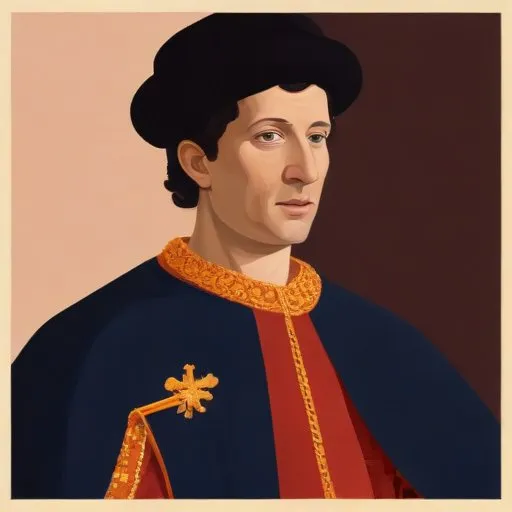
A wealthy and influential patron of the arts, supporting renowned artists like Botticelli and Michelangelo, and playing a significant role in shaping the Renaissance art scene.
Lorenzo di Pierfrancesco de Medici, nicknamed the Popolano, was a prominent Italian banker and politician of the Medici family, known for his liberal views, poetic talents, and patronage of renowned artists and humanists of the Renaissance. As a member of the junior branch of the House of Medici, Lorenzo played a significant role in shaping the cultural and financial landscape of Florence during the late 15th century.
Born on August 4, 1463, in Florence, Lorenzo was the son of Pierfrancesco de Medici the Elder and Laudomia Acciaioli. Following his father's death in 1476, Lorenzo and his brother Giovanni came under the tutelage of their cousin, Lorenzo il Magnifico, the effective ruler of Florence. Under his guidance, Lorenzo received an exceptional education, studying under notable Florentine Renaissance humanists such as Marsilio Ficino, Angelo Poliziano, and Giorgio Antonio Vespucci, uncle of the famous navigator Amerigo Vespucci.
Lorenzo's love for art and literature led him to commission several notable works, including an illuminated manuscript of Dante's Divine Comedy, featuring artwork by the celebrated artist Sandro Botticelli. This manuscript, created around 1485, showcases Lorenzo's refined taste and commitment to promoting the arts.
Lorenzo's banking career was marked by both financial difficulties and impressive accomplishments. He faced significant financial challenges, including forced loans imposed by his cousin Lorenzo il Magnifico, but eventually received repayment of over half of the owed amount in 1485. Despite these obstacles, Lorenzo emerged as a respected banker and politician, known for his liberal views and artistic patronage.
Lorenzo's friendship with Amerigo Vespucci, whom he met during his studies, is a notable aspect of his life. Amerigo would later send his famous letters on the New World to Lorenzo, who supported his voyages and explorations. This connection highlights Lorenzo's fascination with the arts, science, and exploration.
Lorenzo di Pierfrancesco de Medici's life and legacy are a testament to the cultural and intellectual vibrancy of Renaissance Florence. His patronage of the arts, support of humanist scholars, and contributions to the banking sector have left an indelible mark on the history of the Medici family and the city of Florence.
Lorenzo di Pierfrancesco de Medici's life was a testament to the power of art, education, and innovation, and his legacy continues to inspire and captivate us to this day.
Born in 1535
The second shortest-reigning pope in history, serving for just 27 days in 1605, he is most known for his brief but tumultuous papacy marked by power struggles and controversy.
Born in 1469
Italian historian and philosopher who wrote "The Prince", a seminal work on politics and power that still influences modern leadership and governance today.
Born in 1452
A Dominican friar who preached about moral reform and prophesied the downfall of corrupt rulers, leading a short-lived theocratic government in Florence before being executed. He's known for his fiery sermons and clashes with the powerful Medicis.
