


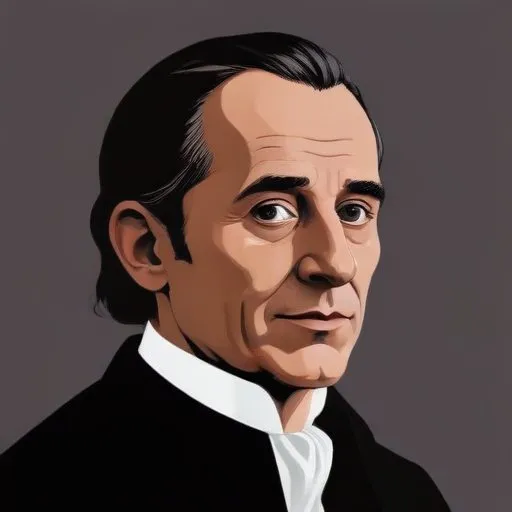
A pioneer in financial mathematics, developing the theory of random walks and Brownian motion, which laid the foundation for modern finance and options pricing.
Louis Bachelier is widely recognized as the first person to model the stochastic process now known as Brownian motion, and his work has had a profound impact on the world of finance. His doctoral thesis, "The Theory of Speculation," defended in 1900, introduced the first mathematical model of Brownian motion and its use for valuing stock options, making him a pioneer in the study of stochastic processes.
Bachelier was born in Le Havre, France on March 11, 1870, to a family of wine merchants and amateur scientists. Tragedy struck early when both of his parents died shortly after he completed his high school diploma, leaving him to care for his sister and three-year-old brother and take over the family business. This practical experience in finance would later influence his academic pursuits.
Despite the setbacks, Bachelier was determined to continue his education. He arrived in Paris in 1892 to study at the Sorbonne, where he struggled to balance his academic responsibilities with his family obligations. His grades were less than ideal, but he persevered and eventually defended his doctoral thesis.
Bachelier's thesis was a groundbreaking work that applied mathematics to the study of finance, a field that was largely unfamiliar to mathematicians at the time. Although his work was not immediately recognized by the academic community, it laid the foundation for modern mathematical finance.
The Bachelier model, as it came to be known, was the first to describe the stochastic process of Brownian motion and its application to stock options. This innovative approach would later influence the development of other models, including the Black-Scholes model.
Today, Louis Bachelier is hailed as the father of mathematical finance, and his work has had a lasting impact on the field. His pioneering efforts paved the way for others to follow, and his model remains an essential tool for finance professionals around the world.
In addition to his contributions to finance, Bachelier's work has also influenced fields such as economics, physics, and engineering. His legacy extends beyond academia, with his models and theories being applied in various industries, from banking and insurance to environmental science and computer networks.
Despite his significant contributions to finance, Bachelier's personal life was marked by tragedy and hardship. He struggled to secure a teaching position in France, and his academic career was cut short by World War I. He served in the war and was later employed by the French Treasury, where he worked until his retirement.
Throughout his life, Bachelier remained dedicated to his work, publishing numerous papers and books on mathematics and finance. His perseverance and dedication to his craft have inspired generations of mathematicians and finance professionals.
"The past, the present and the future are not, in reality, distinct. They are merely different aspects of the same thing." - Louis Bachelier
This quote reflects Bachelier's unique perspective on time and probability, which was central to his work on Brownian motion and mathematical finance.
Louis Bachelier's work has had a profound impact on modern society, from the way we think about risk and uncertainty to the development of complex financial instruments. His theories and models have been applied in a wide range of fields, from finance and economics to environmental science and computer networks.
Today, Bachelier's legacy continues to inspire innovation and advancement in these fields, shaping the way we live, work, and interact with each other.
Louis Bachelier's remarkable story is a testament to the power of perseverance, dedication, and innovation. His groundbreaking work has left an indelible mark on the world of finance and beyond, inspiring generations to come.
Born in 1854
A pioneer in mathematics and physics, he laid the foundations for modern chaos theory, topology, and relativity, making groundbreaking contributions to our understanding of space and time.
Born in 1749
Developed nebular hypothesis of the origin of the solar system and formulated Laplace's equation, a fundamental concept in mathematics and physics. He's considered the founder of celestial mechanics.
Born in 1871
A French mathematician and politician who made significant contributions to probability theory, measure theory, and topology, and served as a minister in the French government.
Born in 1886
Developed theories on probability, stochastic processes, and functional analysis, making significant contributions to modern mathematics.
Born in 1903
Developed theories on probability, topology, and complexity, making significant contributions to modern mathematics and computer science.
Born in 1894
Pioneering mathematician and philosopher who laid the foundations for cybernetics, exploring the intersection of humans, machines, and society. His work has far-reaching implications for artificial intelligence, automation, and modern technology.
