


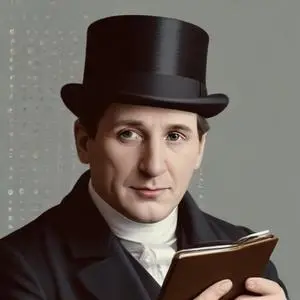
A French educator who invented a system of raised dots that allows blind people to read and write, revolutionizing education and communication for the visually impaired.
Louis Braille, a French educator and inventor, revolutionized the lives of visually impaired people worldwide by creating a reading and writing system that bears his name – Braille. This innovative tactile code, developed in the early 19th century, enables individuals with visual impairments to access information and communicate with unprecedented ease.
Louis Braille was born on January 4, 1809, in Coupvray, France, to Simon-René and Monique Braille. A tragic accident at the age of three left him blind in both eyes. Despite this setback, Braille's determination and aptitude for learning earned him a scholarship to France's Royal Institute for Blind Youth.
Inspired by Charles Barbier's night writing system, Braille began developing his own tactile code while still a student at the Institute. By the age of 15, he had refined his system, which was more compact and versatile than its precursor. Braille's innovative approach enabled rapid reading and writing, even extending to music notation.
In 1824, Braille presented his system to his peers, showcasing its potential to empower visually impaired individuals. Although initially met with skepticism, Braille's invention eventually gained recognition, albeit posthumously.
Braille served as a professor at the Royal Institute for Blind Youth, where he continued to refine and expand his system. He also pursued a passion for music, becoming an accomplished organist. Throughout his life, Braille remained dedicated to improving the lives of visually impaired people, tirelessly advocating for their inclusion and accessibility.
Today, Braille's system is used globally, with more than 30 languages adapted to the tactile alphabet. His invention has enabled countless individuals with visual impairments to access education, employment, and social opportunities, promoting independence and integration.
Braille's work embodies a profound understanding of the importance of accessibility and inclusivity. His dedication to empowering visually impaired individuals reflects a deep-seated commitment to promoting equality and social justice.
Braille's pioneering work has been recognized with numerous awards and honors, including his induction into the Hall of Fame for Leaders and Legends of the Blindness Field. His legacy continues to inspire generations of educators, innovators, and advocates for the visually impaired.
Louis Braille's groundbreaking invention has left an indelible mark on the world, empowering millions of visually impaired individuals to access knowledge, opportunities, and social connections. His legacy continues to inspire innovation, promote inclusivity, and celebrate the potential of individuals with visual impairments.
Born in 1880
A deaf and blind individual who learned to communicate and read, becoming a renowned writer and advocate for people with disabilities. Known for her remarkable achievements and inspiring story.
Born in 1847
A Scottish-American engineer and academic credited with inventing the telephone, revolutionizing real-time communication. This innovation transformed the way people connect and conduct business.
Born in 1847
A pioneer in innovation, credited with developing groundbreaking inventions that revolutionized the way people live and communicate, including the light bulb and phonograph.
Born in 1866
Taught Helen Keller, a deaf and blind girl, to communicate and read, revolutionizing special education. Her innovative methods and dedication enabled Keller to graduate from college and become a renowned author and speaker.
Born in 1821
Founded the American Red Cross, providing humanitarian aid and disaster relief, and pioneering nursing education. Known for her courageous and selfless efforts during the Civil War and beyond.
Born in 1820
Pioneering nurse and statistician who revolutionized healthcare by introducing sanitation practices and data-driven decision making, becoming the founder of modern nursing.
Born in 1802
Pioneering nurse and social reformer who crusaded for humane treatment of the mentally ill and prisoners, establishing asylums and advocating for their rights.
