


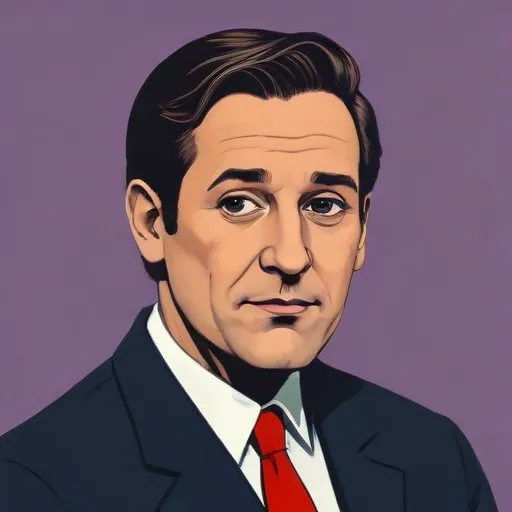
American journalist and actor who reported on World War I and later appeared in over 200 films and TV shows, often playing authority figures.
Louis Jean Heydt was an American character actor who made a name for himself in film, television, and theatre, often typecast in hapless, ineffectual, or fall guy roles. With a career spanning over three decades, Heydt became a familiar face in Hollywood, appearing in over a hundred films and numerous stage productions.
Born on April 17, 1903, in Montclair, New Jersey, Heydt was the son of German parents George Frederick Heydt, a jeweler and secretary to Louis Comfort Tiffany, and Emma Foerster. He was educated at Montclair High School, Worcester Academy, and Dartmouth College, graduating in 1926. Initially, Heydt aspired to be a journalist and worked as a reporter for The New York World.
Heydt's introduction to the theatre came when he visited a classmate backstage during the rehearsal of The Trial of Mary Dugan. His journalist background caught the attention of the producers, who offered him a role as a reporter in the play. This debut marked the beginning of his stage career, with Heydt going on to appear in a dozen plays, including Strictly Dishonorable, Before Morning, and Happy Birthday. He also played the male lead in the London company of The Trial of Mary Dugan, replacing the deceased Rex Cherryman.
In the 1930s, Heydt transitioned to Hollywood, where he appeared in over a hundred films, including Gone with the Wind (1939), The Great McGinty (1940), Thirty Seconds Over Tokyo (1944), and The Big Sleep (1946). He made a notable impression as an older, warmhearted soldier in John Ford's They Were Expendable (1945) and costarred in the 1951 film noir Roadblock alongside Charles McGraw. Heydt remained active in Hollywood throughout the 1950s, appearing in 32 films through 1959.
Heydt was an early adopter of television, moving into the new medium with ease. He appeared in numerous TV shows, taking on a range of characters in various genres.
Heydt was married and actively participated in summer stock theatre with his wife in Skowhegan, Maine, during the mid-1930s. He passed away on January 29, 1960, leaving behind a legacy as a talented character actor who brought depth and nuance to his many roles.
Born in 1901
A legendary actor who epitomized Hollywood's Golden Age, starring in iconic films like "Gone with the Wind" and charming audiences with his rugged, debonair persona.
Born in 1900
Academy Award-winning star of Hollywood's Golden Age, known for iconic on-screen partnership with Katharine Hepburn and memorable roles in classics like "Inherit the Wind" and "Guess Who's Coming to Dinner".
Born in 1911
A blonde bombshell and sex symbol of the 1930s, known for her iconic film roles and tumultuous personal life.
Born in 1892
A debonair leading man of Hollywood's Golden Age, starring in classic films like "The Thin Man" series and "My Man Godfrey," known for his suave, witty on-screen presence.
Born in 1905
Star of classic Hollywood films, particularly in the screwball comedy genre, known for her sophisticated on-screen presence and iconic roles in movies like "The Thin Man" series.
Born in 1897
Acclaimed filmmaker behind iconic movies like "It's a Wonderful Life" and "Mr. Smith Goes to Washington", known for heartwarming, socially conscious storytelling.
Born in 1894
Acclaimed filmmaker behind iconic Westerns and dramas, credited with shaping the American cinematic landscape with his visually stunning and emotionally charged storytelling.
Born in 1896
Pioneering filmmaker behind classic movies like "Scarface" and "His Girl Friday", known for his versatile directing style and witty dialogue.
