


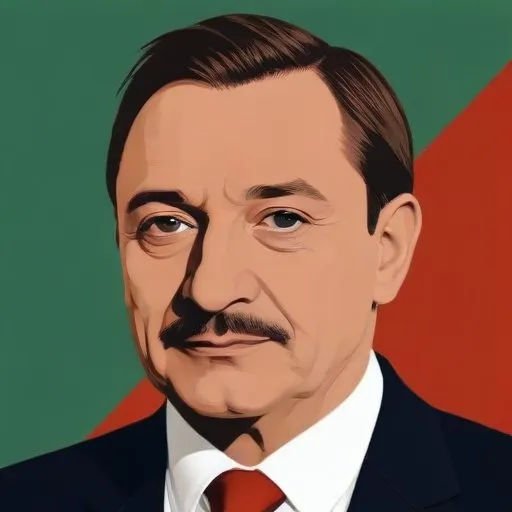
The 33rd Prime Minister of Hungary, a politician and diplomat who served during World War II and was involved in the country's fascist regime. He is known for his role in Hungary's involvement in the war and the subsequent war crimes trials.
László Bárdossy, a Hungarian diplomat and politician, is infamous for being the mastermind behind Hungary's involvement in World War II. As Prime Minister of Hungary from April 1941 to March 1942, Bárdossy's pro-German foreign policy led to Hungary's participation in the war, resulting in devastating consequences for the country and its people.
Born on December 10, 1890, in Szombathely, Hungary, Bárdossy was the son of Jenő Bárdossy de Brdos and Gizella Zárkányi de Felső. He completed his secondary education in Eperjes (now in Slovakia) and Budapest, before training as a lawyer in Budapest, Berlin, and Paris. Bárdossy was well-versed in German, French, and English, skills that would serve him well in his future diplomatic career.
He began his career in 1913 as an assistant clerk in the Hungarian government's Ministry of Culture and Education. By 1918, he had risen to the rank of assistant secretary, and three years later, he became a ministerial secretary. In 1922, he transferred to the newly established Ministry of Foreign Affairs, where he worked as deputy chief and later chief of the press department.
In March 1930, Bárdossy was appointed as a counsellor to the Hungarian legation in London, and later became chargé d'affaires. From October 1934, he served as the Hungarian envoy to Romania. His experience and connections earned him the position of Foreign Minister in January 1941, and following Pál Teleki's suicide in April, he succeeded as Prime Minister of Hungary.
As Prime Minister, Bárdossy pursued a strong pro-German foreign policy, seeking to recover Hungarian territories lost after the Treaty of Trianon. This led to Hungary's involvement in World War II, supporting and subsequently joining Germany's invasion of Yugoslavia. Subsequently, Hungary declared war on the Soviet Union, the United Kingdom, and the United States.
In March 1942, Regent Miklós Horthy dismissed Bárdossy from the post of Prime Minister. After the German occupation of Hungary in 1944, Bárdossy collaborated with the collaborationist governments. Following the end of the war, he was arrested, tried, and found guilty of war crimes and collaborationism by a People's Court. On January 10, 1946, he was executed by firing squad.
Bárdossy's involvement in World War II and his role in Hungary's war crimes led to his downfall and execution. His legacy serves as a warning about the dangers of nationalism and the devastating consequences of involving oneself in global conflicts.
Bárdossy's story serves as a reminder of the importance of responsible leadership and the need for diplomacy to prioritize peace and cooperation over aggression and war.
Born in 1868
Led a right-wing authoritarian government in Hungary between the two World Wars, known for his anti-Semitic and nationalist policies. He collaborated with Nazi Germany during World War II.
Born in 1892
A Hungarian communist leader who ruled the country with an iron fist from 1949 to 1956, known for his brutal suppression of dissent and forced industrialization.
