


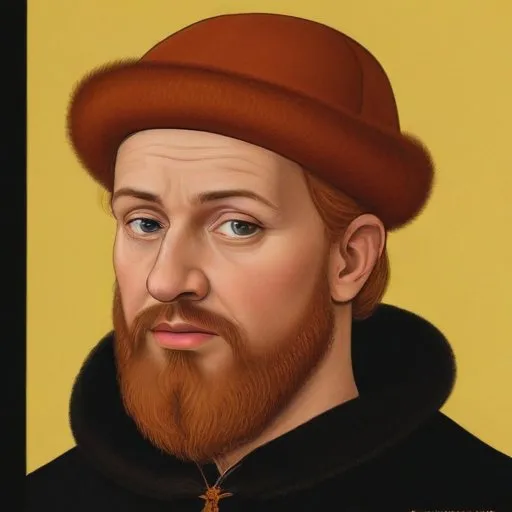
A prominent painter of the German Renaissance, renowned for his vivid altarpieces and portraits that blended realism with subtle symbolism.
Lucas Cranach the Younger was a renowned German Renaissance painter and portraitist, celebrated for his exquisite works of art that adorned the walls of churches, schools, castles, and noble houses. As the son of Lucas Cranach the Elder, he continued his father's legacy, producing iconic images of Protestant Reformers, including Martin Luther.
Born on October 4, 1515, in Wittenberg, Germany, Cranach the Younger began his artistic journey as an apprentice in his father's workshop, alongside his older brother, Hans. ThisTraining provided him with the necessary skills to excel in the art world.
Following the sudden death of his brother Hans in 1537, Cranach the Younger assumed greater responsibilities in his father's workshop. His father's departure in 1550 tojoin his patron, John Frederick I, Elector of Saxony, in exile, led to Cranach the Younger taking full control of the family workshop. He successfully maintained the workshop's high output of quality work, cementing his reputation as a prominent artist.
Cranach the Younger's work was characterized by its mastery of composition, color, and detail. His portraits of Protestant Reformers, such as Martin Luther, are considered some of the most iconic images of the Reformation era. His artistic style blended traditional Renaissance techniques with a unique, Protestant sensibility, making him a leading producer of Protestant artistic propaganda.
In addition to his artistic prowess, Cranach the Younger was a successful businessman and politician. He occupied several political offices in Nuremberg, including serving on the city council, as Chamberlain, and as Burgomaster. His marriage to Barbara Brück, daughter of Gregor Brück, Luther's legal advisor, further solidified his connection to the Protestant elite.
Upon his death in 1586, theologian Georg Mylius stated that Cranach the Younger's work could be seen in churches, schools, castles, and houses throughout the region. His legacy extends beyond his art, as he played a significant role in shaping Protestant visual culture and contributing to the Reformation's artistic heritage.
Theologian Georg Mylius, upon Cranach the Younger's death, stated, "His works can be seen in churches and schools, in castles and houses."
Cranach the Younger's work served as a visual representation of the Protestant Reformation, providing a unique window into the artistic and cultural landscape of 16th-century Europe. His art continues to influence artists, historians, and scholars to this day, cementing his place as a Renaissance master.
Born in 1471
A Renaissance master of intricate woodcuts and engravings, known for precise and detailed depictions of nature and human form, influencing art and mathematics for centuries.
