


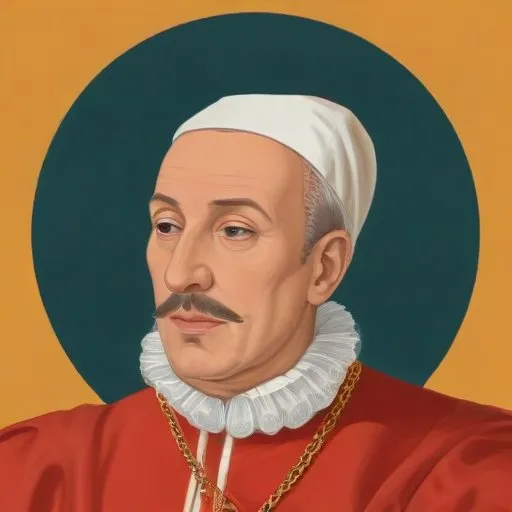
Ruler of Mantua, a powerful city-state in Renaissance Italy, known for his cultural patronage and commissioning famous artists like Andrea Mantegna. He transformed Mantua into a hub of art and culture.
Ludovico III Gonzaga, also known as "il Turco" or "the Turk," was a renowned condottiero and statesman who ruled the city of Mantua from 1444 to 1478. As a skilled military leader and shrewd diplomat, he navigated the complex web of alliances and rivalries in 15th-century Italy, earning the respect of his contemporaries and leaving a lasting legacy in the region.
Ludovico was born on June 5, 1412, to Gianfrancesco I Gonzaga and Paola Malatesta, daughter of Malatesta IV Malatesta of Pesaro. His family had a long history of producing notable condottieri, and Ludovico would follow in their footsteps, fighting alongside his father from a young age.
In 1432, Ludovico began his military career as a condottiero in the army of Francesco Busone. He later entered the service of the Visconti of Milan, which led to a temporary exile from Mantua and a rift with his father. However, the two reconciled in 1441, and Ludovico succeeded his father as Marquis of Mantua in 1444.
Ludovico's military prowess and strategic alliances played a crucial role in maintaining Mantua's independence and influence during a time of great turmoil in Italy. He fought on behalf of various city-states, including Milan, Florence, Venice, and Naples, and participated in several key battles, including the Battle of Caravaggio in 1448.
As Marquis of Mantua, Ludovico implemented several reforms to strengthen the city's economy and governance. He promoted agriculture, encouraged trade, and reorganized the city's administrative structure, earning the appreciation of his subjects.
Ludovico married Barbara of Brandenburg in 1433, with whom he had several children. He was known for his cultural patronage, commissioning works from prominent artists and architects, such as Leon Battista Alberti and Luca Fancelli. Ludovico's legacy extends beyond his military and political achievements, as he played a significant role in shaping the cultural and artistic landscape of Renaissance Italy.
Although few direct quotes from Ludovico III Gonzaga have survived to the present day, his letters and dispatches provide valuable insights into his thoughts on statecraft, diplomacy, and military strategy.
Ludovico III Gonzaga's life and reign coincided with a period of significant upheaval in Italy, marked by the rise of powerful city-states, the challenges posed by the Ottoman Empire, and the refinement of Renaissance humanism. His legacy as a skilled military leader, shrewd diplomat, and patron of the arts has endured, earning him a place among the most notable figures of the Italian Renaissance.
Born in 1474
Renowned for epic poems, particularly "Orlando Furioso", which masterfully blended chivalric romance and Renaissance humanism, influencing literature for centuries.
Born in 1469
Italian historian and philosopher who wrote "The Prince", a seminal work on politics and power that still influences modern leadership and governance today.
Born in 1487
A 16th-century Pope who commissioned Michelangelo to paint the Sistine Chapel's frescoes and was a patron of the arts, leaving a lasting impact on Renaissance art and architecture.
Born in 1452
Renaissance mastermind behind iconic works like the Mona Lisa and The Last Supper, who revolutionized art, science, and engineering with his inventive and curious nature.
Born in 1475
A ruthless and cunning politician who rose to power in the Renaissance era through intrigue and military conquest, leaving a lasting legacy in politics and governance.
