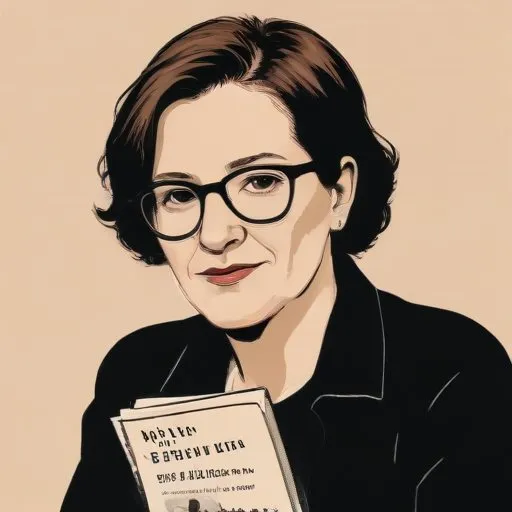
The Minutiae Master: Unpacking the Enigmatic World of Lydia Davis
The Art of Brevity: Where Less is More
Lydia Davis, the critically acclaimed American short story writer, novelist, essayist, and translator, has made a name for herself in the literary world with her unique brand of sparse, introspective prose. Her short stories, often no longer than a page or two, offer a glimpse into the human experience, laid bare in all its complexity.
A Life of Letters
Born on July 15, 1947, in Northampton, Massachusetts, Davis was raised in a family of writers and critics. Her parents, Robert Gorham Davis and Hope Hale Davis, instilled in her a love for literature from an early age. Davis's own writing journey began with music, first as a pianist and later as a violinist, before eventually turning to writing.
Education and Early Influences
Davis attended the Putney School, where she developed a passion for poetry. She later studied at Barnard College, where she honed her writing skills. It was during this period that she met her future husband,
Paul Auster, with whom she had a son, Daniel. The couple later divorced, and Davis married artist Alan Cote, with whom she had another son, Theo.
A Career of Distinction
Davis's literary career spans over four decades, during which she has published six collections of fiction, including
The Thirteenth Woman and Other Stories (1976) and
Break It Down (1986), a finalist for the PEN/Hemingway Award. Her most recent collections,
Varieties of Disturbance (2007) and
Cant and Won't (2013), have solidified her reputation as a master of the short story form.
A Translator's Touch
In addition to her original work, Davis has also made significant contributions as a translator of French literary classics. Her translations of
Marcel Proust's
Swann's Way and
Gustave Flaubert's
Madame Bovary have been widely acclaimed.
Awards and Accolades
Throughout her career, Davis has received numerous awards and honors for her work, including the Man Booker International Prize (2013) and the National Medal of Arts (2014). She has also been a finalist for the National Book Award and the PEN/Hemingway Award.
Teaching and Sharing Her Craft
Davis has shared her expertise with students at the University at Albany, SUNY, where she is a professor of creative writing. She has also been a
Lillian Vernon Distinguished Writer-in-Residence at New York University.
Legacy and Impact
Lydia Davis's unique brand of literary minimalism has influenced a generation of writers and readers. Her commitment to the short story form has helped to revitalize interest in this often-overlooked genre. Through her writing and teaching, Davis continues to inspire and challenge her readers, ensuring her place as one of the most important literary voices of our time.
Quotes and Insights
- "I think of myself as a writer who doesn't write about big subjects, but about little ones." - Lydia Davis
- "I'm interested in the way people think, the way they speak, the way they try to hide their thoughts." - Lydia Davis
A Life of Quiet Intensity
Through her writing, Lydia Davis invites us to slow down, to observe the minutiae of human experience, and to find beauty in the everyday. Her life's work is a testament to the power of language to capture the essence of the human condition.
FAQ
What is Lydia Daviss literary style?
Lydia Davis is known for her short, concise, and often humorous stories that explore the human condition. Her writing is characterized by its precision, subtlety, and ability to convey complex emotions and ideas through simple, everyday scenarios.
What awards has Lydia Davis won for her writing?
Davis has won numerous awards, including the Man Booker International Prize in 2013, the National Book Award, and a MacArthur Fellowship. Her work has been widely praised for its innovative style and profound insights into human nature.
What is the significance of Lydia Daviss short stories?
Daviss short stories are remarkable for their ability to capture the essence of modern life, revealing the complexities and contradictions of human relationships, emotions, and experiences. Her work has been hailed as a major contribution to contemporary American literature.
How does Lydia Daviss writing reflect her personal life and experiences?
While Daviss writing is not strictly autobiographical, it is informed by her observations of everyday life, her relationships, and her own emotions. Her stories often explore themes of love, family, and identity, reflecting her interest in the human condition.
What is Lydia Daviss teaching philosophy?
As a writing instructor, Davis emphasizes the importance of precision, clarity, and honesty in writing. She encourages students to explore their own voices and perspectives, fostering a creative environment that nurtures innovative storytelling and self-expression.