


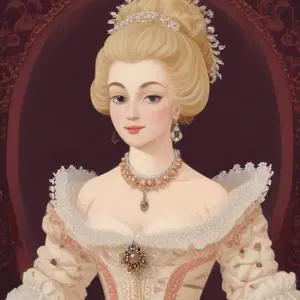
The last mistress of Louis XV, known for her lavish lifestyle, extravagant fashion sense, and significant influence on the king's decisions, ultimately leading to her downfall during the French Revolution.
Madame du Barry, born Jeanne Bécu, was the last maîtresse-en-titre of King Louis XV of France, a position that brought her unparalleled wealth, power, and influence. However, her humble beginnings as a courtesan and her rapid ascent to the royal court also earned her the scorn of many, including the future Queen Marie Antoinette.
Madame du Barry's entry into the royal court was nothing short of scandalous. In 1768, the 25-year-old Jeanne was hastily married to Comte Guillaume du Barry, a high courtier, to satisfy etiquette requirements. The ceremony was accompanied by a falsified birth certificate, which obscured her poor background and made her appear three years younger. This ruse allowed her to become the king's official paramour, a position that came with immense power and wealth.
As the king's mistress, Madame du Barry lived a life of unparalleled opulence. She was showered with gifts, including the most extravagant jewels, and was given a lavish apartment in the Palace of Versailles. Her fashion sense was legendary, and she was known for her exquisite taste in clothing, jewelry, and perfumes. Her beauty and charm captivated the king, and she soon became the most powerful woman in France.
Madame du Barry's rapid rise to power was not without its controversies. Many at court, including Marie Antoinette, disapproved of her humble origins and her scandalous past. They viewed her as a usurper, who had manipulated her way into the king's affections. The queen's contempt for Madame du Barry was so great that it caused tension and dissension at court, with many courtiers taking sides.
During the Reign of Terror, Madame du Barry's fortunes took a dramatic turn. Accused of treason by her own slave, Zamor, she was imprisoned and eventually executed by guillotine on December 8, 1793. Her body was buried in the Madeleine cemetery, and her fabulous jewels were sold at auction in 1795.
Madame du Barry's legacy is complex and multifaceted. While her life was marked by scandals and controversies, she also played a significant role in shaping French fashion and culture. Her influence on the arts and design was immense, and her love of beauty and elegance continues to inspire artists and designers to this day.
Madame du Barry's life was a testament to the power of beauty, charm, and determination. Despite her tumultuous relationships and controversial past, she remains one of the most fascinating figures of the French monarchy, and her legacy continues to captivate and inspire to this day.
Born in 1710
The monarch who ruled France from 1715 to 1774, known as the "Sun King's" great-grandson, and remembered for his extravagance, absolutism, and the decline of the French monarchy.
Born in 1703
A prominent artist of the Rococo style, known for his delicate and ornate paintings, often depicting mythological and pastoral scenes, as well as designing sets for the Paris Opera.
Born in 1732
A prolific Rococo painter and etcher, renowned for his delicate, whimsical, and often erotic works that capture the carefree spirit of 18th-century French aristocracy. His art often featured lush landscapes, gentle colors, and playful scenes of love and leisure.
