


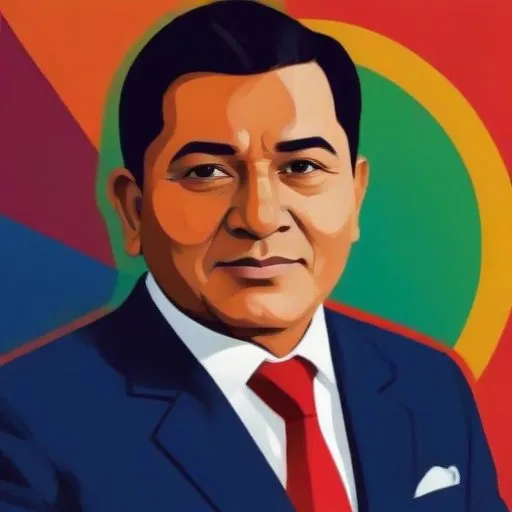
A Nepalese communist leader who played a significant role in the country's democratic movement, advocating for people's rights and social justice.
Madan Bhandari, a prominent Nepalese political leader, is widely regarded for propounding the popular communist principle of Peoples Multiparty Democracy, which led to a landslide victory in the 1991 general election. His charismatic style and visionary leadership peaked the Nepalese communist movement to a greater height, cementing his position as one of the most influential figures in Nepalese politics.
Born on 27 June 1951, in Dhungesangu village of Taplejung district in eastern Nepal, Bhandari's thirst for knowledge led him to study at Medibung School in Taplejung and later in Varanasi, India.
In 1972, Bhandari became a central committee member of the Janabadi Sanskritik Morcha Democratic Cultural Front, a student movement established by Pushpa Lal Shrestha. He later left Pushpa Lal's Communist Party of Nepal to create the Mukti Morcha Samuha Liberation Front Group, which formed an alliance with the survivors of the Jhapa Movement in 1978.
He was a founding member of the Communist Party of Nepal Marxist-Leninist preceding the 1980 referendum and was elected General-Secretary at its Fourth National Congress in 1986. Bhandari's leadership skills and vision led to the merger of the CPN ML into the Communist Party of Nepal Unified Marxist-Leninist in 1991, where he became the General-Secretary.
Under Bhandari's leadership, the CPN UML won all but one seat in the Himalayan capital in the 1991 elections, the country's first free election. This historic win not only propelled the CPN UML to the forefront of Nepalese politics but also solidified Bhandari's position as a trailblazer in the country's communist movement.
Madan Bhandari's untimely death in a jeep accident in 1993 did not diminish his impact on Nepalese politics. His Peoples Multiparty Democracy principle continues to inspire and influence the country's politicallandscape. His legacy is a testament to his unwavering commitment to the people of Nepal and his unrelenting pursuit of a more equitable society.
Madan Bhandari's visionary leadership and commitment to the people of Nepal have inspired generations of politicians, activists, and citizens. His Peoples Multiparty Democracy principle continues to shape the country's political discourse, and his legacy serves as a beacon of hope for a more just and equitable society.
Bhandari's philosophical contributions to Nepalese politics are rooted in his unwavering commitment to the principles of communism and democracy. He believed in the power of the people and worked tirelessly to empower them through his Peoples Multiparty Democracy principle.
His legacy is a testament to the enduring power of his ideas and his unrelenting pursuit of a better future for the people of Nepal.
80 Years Old
The 32nd Prime Minister of Nepal, known for leading the country through a period of significant political and economic change, and playing a key role in drafting the country's new constitution.
