


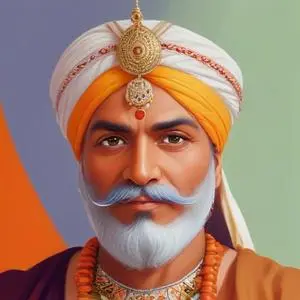
A powerful ruler of Mewar, known for his bravery and military prowess, who fought against the Mughal Empire and expanded his kingdom through strategic alliances and conquests.
Maharana Sangram Singh, popularly known as Rana Sanga, is revered as one of the most valiant and powerful rulers of Mewar in the 16th century. His extraordinary leadership and military prowess transformed the kingdom into the most dominant state in northern India, earning him the admiration of his contemporaries, including the Mughal Emperor Babur.
Born to King Raimal and Queen Ratan Kunwar, a Jhala princess of Halvad, Sangram Singh's birth was marked by auspicious astrological planetary positions. Although the exact year of his birth is unknown, his early life was marked by a strong sense of ambition and a thirst for power.
Sangram Singh's reign was characterized by a series of unbroken military successes against neighboring sultanates. He captured significant portions of the Malwa Sultanate following the Battle of Gagron in 1519 and appointed Medini Rai as his vassal to rule over it. The Sultan of Gujarat was humbled on multiple occasions, and the Lodi dynasty of Delhi was defeated at Khatoli, Dholpur, and Ranthambhore.
For the first time since the Second Battle of Tarain, Sangram Singh united several Rajput clans under his leadership, forging an alliance that would challenge the invading forces of Babur. Despite initial success at Bayana, the Maharana suffered a significant defeat at the Battle of Khanwa, largely due to Babur's strategic use of gunpowder weaponry, which was unknown in northern India at the time.
The defeat at Khanwa marked a turning point in Indian history, paving the way for the Mughal conquest of northern India. However, Sangram Singh's bravery and leadership left an indelible mark on Indian history. He is remembered as the bravest of all Rajputs and the Hindu Emperor Hindupati of northern India. His reign continues to inspire generations, serving as a testament to his unwavering courage and unrelenting passion for his kingdom.
Sangram Singh's leadership was guided by a strong sense of duty towards his kingdom and his people. He believed in the importance of unity and cooperation among the Rajput clans, and his military campaigns were often motivated by a desire to protect and expand his kingdom.
The Maharana's legacy continues to inspire generations, serving as a symbol of courage, leadership, and patriotism. His military campaigns and leadership have been studied by historians and scholars, providing valuable insights into the art of war and statecraft.
Sangram Singh's reign marked a significant turning point in Indian history, marking the beginning of the Mughal conquest of northern India. His bravery and leadership have been immortalized in historical texts and continue to be celebrated by Indians and Rajputs around the world.
