


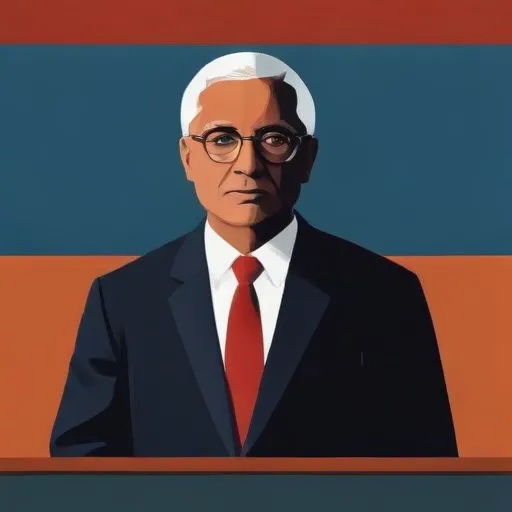
A Indian lawyer and politician who fought for the rights of tribal people and was a key figure in the formation of the Salwa Judum, a militia that aimed to counter Maoist insurgency. He was assassinated in 2013.
Mahendra Karma, a prominent Indian political leader, is renowned for his valiant efforts in combating the Naxalite menace in Chhattisgarh, particularly through the Salwa Judum movement. Throughout his illustrious career, he fearlessly confronted the Maoist insurgency, earning him the respect and admiration of the people.
Karma's foray into politics began with the Communist Party of India (CPI), under whose banner he won the 1980 general elections. He later switched to the Indian National Congress, where he made significant strides, becoming the first president of the Zila Panchayat of the undivided Bastar. In 1996, he was elected as a Member of Parliament (MP) on an independent ticket from Bastar, further solidifying his position in the political arena.
In 2005, Karma played a pivotal role in organizing the Salwa Judum movement, a grassroots initiative aimed at countering the Naxalite threat in Chhattisgarh. This movement, which translates to "peace march" in the local Gondi language, sought to empower the local populace to resist the Maoist insurgency, thereby reclaiming their territory and restoring peace.
Karma's ministerial stint saw him hold the portfolio of Industry and Commerce in the Ajit Jogi cabinet from 2000 to 2004. During this period, he worked tirelessly to promote industrial development in the state, creating avenues for economic growth and employment opportunities. His leadership was characterized by his unwavering commitment to the people, which earned him the respect of his peers and adversaries alike.
Karma hailed from a prominent tribal family in the Bastar region. His father, Daraboda Karma, was a respected leader in the undivided Bastar region. Mahendra's elder brother, Lakshman Karma, was a Member of Parliament, while his younger brother, Podiyaram, was president of the Bhairamgad Janpad Panchayat before being assassinated by the Naxalites. His sons, Chavindra Karma and Deepak Karma, continued the family's legacy, with Chavindra serving as the Jila Panchayat Chairman of Dantewada and Deepak as the Nagar Panchayat president of Dantewada.
Tragically, Mahendra Karma's life was cut short on 25 May 2013, when he was assassinated by Naxalites while returning from a Parivartan Rally meeting in Sukma. His martyrdom served as a rallying cry for the people, who saw him as a champion of their rights and a symbol of resistance against the Maoist insurgency. Through his courageous endeavors, Karma left an indelible mark on the politics of Chhattisgarh, inspiring generations to come.
Mahendra Karma's political ideology was rooted in his firm belief in the power of the people. He advocated for grassroots-level empowerment, recognizing that true change could only be effected through collective action. His unwavering commitment to the Salwa Judum movement served as a testament to his conviction that the people themselves must be the driving force behind any meaningful change.
Mahendra Karma's life and legacy are inextricably linked to the turbulent history of Chhattisgarh. His struggle against the Naxalite menace serves as a poignant reminder of the region's complex dynamics and the enduring spirit of its people. As a champion of peace and development, Karma's contributions continue to inspire and motivate future generations, ensuring that his legacy endures.
75 Years Old
The Chief Minister of Gujarat and 14th Prime Minister of India, a prominent figure in Indian politics, known for his economic reforms and nationalist agenda. He has been a dominant force in Indian politics for over two decades.
56 Years Old
Indian National Congress leader and scion of the Nehru-Gandhi family, known for his efforts to revitalize the party and promote social justice.
79 Years Old
The first female President of the Indian National Congress, leading the party to a landslide victory in 2004, and playing a crucial role in shaping India's political landscape.
93 Years Old
The 13th Prime Minister of India, a renowned economist who led the country through a period of rapid economic growth and liberalization, implementing reforms that transformed India's economy. He is credited with helping to lift millions of people out of poverty.
90 Years Old
The 13th President of India, a seasoned politician and journalist, served as the head of state from 2012 to 2017, playing a key role in shaping the country's economy and foreign policy. He's known for his diplomatic skills and ability to build consensus.
73 Years Old
Indian lawyer and politician who served as the Minister of Law and Justice, known for his key role in shaping India's economic policies and reforms. He was a prominent figure in Indian politics, known for his eloquence and sharp intellect.
74 Years Old
Indian Minister of External Affairs who played a crucial role in shaping India's foreign policy and was known for her exceptional oratory skills and humanitarian work. She was a powerful voice for Indian diplomacy and a champion of women's empowerment.
