


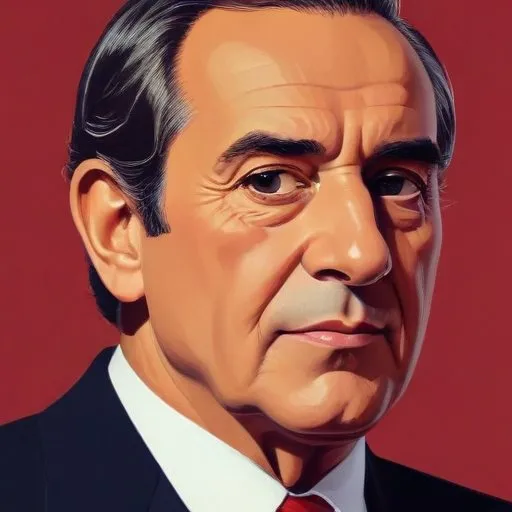
The 7th President of Spain, a key figure in the country's Second Republic, known for his progressive reforms and leadership during the Spanish Civil War.
Manuel Azaña Díaz, the Spanish politician who served as Prime Minister of the Second Spanish Republic twice (1931-1933 and 1936) and later as the last President of the Republic (1936-1939), is best known for his unwavering commitment to democracy and his tireless efforts to modernize and reform the Spanish state.
Azaña's remarkable career spanned over three decades, during which he emerged as a prominent leader of the Republican cause, playing a crucial role in shaping the country's political landscape during the tumultuous Spanish Civil War.
Born into a wealthy family on January 10, 1880, Azaña was orphaned at a very young age. Despite this, he went on to pursue higher education, studying at the Universidad Complutense, the Cisneros Institute, and the Agustinos of El Escorial.
He earned a law degree from the University of Zaragoza in 1897 and later received his doctorate from the Universidad Complutense in 1900. Azaña's academic achievements paved the way for his future success in politics and law.
In 1909, Azaña secured a position at the Main Directorate of the Registries and began practicing civil law as a notary. His interest in politics soon led him to join the Reformist Republican Party in 1914.
During World War I, Azaña's pro-Allies stance earned him recognition, and he became a prominent figure in Spanish politics. His criticism of the Generation of 98 and his advocacy for democracy and modernization set him apart from his contemporaries.
In 1931, Azaña became Minister of War in the Provisional Government, where he implemented significant military reforms aimed at professionalizing the armed forces.
Later that year, he took office as Prime Minister, a position he held until 1933. Azaña's second term as Prime Minister began in 1936, during which he played a crucial role in organizing the Popular Front.
In 1936, Azaña became the President of the Second Spanish Republic, a position he held until the Republic's defeat in 1939.
The outbreak of the Spanish Civil War in 1936 marked a tumultuous period in Azaña's life. Despite his efforts to defend the Republic, the Nationalist forces ultimately prevailed, and Azaña was forced to flee to France in 1939.
He resigned from office and went into exile, where he remained until his death on November 3, 1940, at the age of 60.
Manuel Azaña's dedication to democracy, modernization, and reform has left an indelible mark on Spanish history. His commitment to the principles of equality, justice, and liberty continues to inspire generations.
As a champion of Spanish democracy, Azaña's legacy serves as a powerful reminder of the importance of defending democratic values in the face of authoritarianism and oppression.
Manuel Azaña's remarkable life and legacy continue to inspire and educate, serving as a testament to the power of democracy and the importance of defending human rights.
