


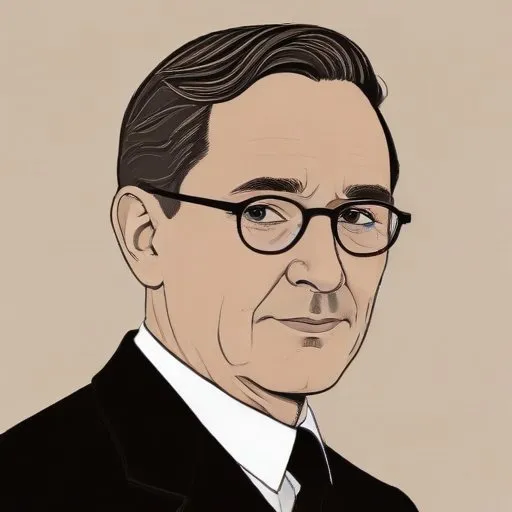
A pioneering historian who shed light on French Canada's past, particularly its colonial era, through meticulous research and engaging writings.
Marcel Trudel, a renowned Canadian historian and author, is celebrated for his groundbreaking work on the history of New France, publishing over 40 books on the subject. His meticulous research and academic rigor brought a new level of precision to an area previously marked by nationalistic and religious biases, contributing significantly to the transformation of Quebec society during the Quiet Revolution.
Trudel was born on May 29, 1917, in Saint-Narcisse-de-Champlain, Quebec, to Hermyle Trudel and Antoinette Cossette. After being orphaned at the age of five, he was adopted by a local couple, Théodore Baril and Marie Trépanier, and went on to show great academic promise. He spent some time at a seminary in Trois-Rivières but soon realized that the priesthood was not his calling. Instead, he pursued his passion for literature and earned a licence ès lettres cum laude in 1941 and a Doctorat ès lettres magna cum laude in 1945, both from Université Laval.
In 1947, Trudel became the first professor of history at Laval's newly founded Institute of History, eventually becoming the head of the History department. Between 1955 and 1960, he published several works that challenged the Catholic hierarchy's views, including those on Chiniquy, the first French Catholic priest to become a Presbyterian minister, and the Canadian Catholic Church under English military government.
Trudel's work was recognized with several prestigious awards, including the Governor General's Literary Award for French Non-Fiction in 1966, and a second nomination in 1987. His contributions to the field of history have left a lasting impact on Canadian academia and beyond.
Marcel Trudel's pioneering work has paved the way for future generations of historians, inspiring a new wave of research and scholarship on New France. His unwavering commitment to academic rigor and critical thinking has earned him a permanent place in the annals of Canadian history.
Through his extensive body of work, Trudel has left an indelible mark on our understanding of New France, challenging previous biases and shedding new light on this pivotal period in Canadian history.
Born in 1919
The charismatic leader who championed Canadian unity and implemented progressive policies, known for his iconic style and influential legacy in shaping modern Canada.
Born in 1922
A charismatic leader who championed Quebec's independence and shaped the province's distinct identity through his passionate politics and journalism. He's revered for his role in Quebec's Quiet Revolution.
92 Years Old
The 20th Prime Minister of Canada, serving from 1993 to 2003, known for his leadership during the Quebec sovereignty movement and his role in shaping Canada's national unity. He implemented policies like the Clarity Act and the National Child Benefit.
45 Years Old
American professional ice hockey player who won two Stanley Cup championships and was a four-time NHL All-Star. Known for his rugged defensive play and physical presence on the ice.
87 Years Old
The 27th Premier of Quebec, a key figure in the Quebec sovereignty movement, known for leading the province's separatist government and negotiating with Canada's federal government.
93 Years Old
The 22nd Premier of Quebec, a Canadian lawyer and politician, served from 1970 to 1976 and again from 1985 to 1994, known for his role in shaping Quebec's economy and politics. He implemented significant hydroelectric projects and negotiated with the Canadian government on provincial autonomy.
84 Years Old
The 40th Mayor of Montreal, a Canadian businessman and politician, is known for his efforts to revitalize the city's economy and infrastructure during his tenure from 1994 to 2001. He's also credited with hosting several international events, including the 2001 Francophonie Summit.
