


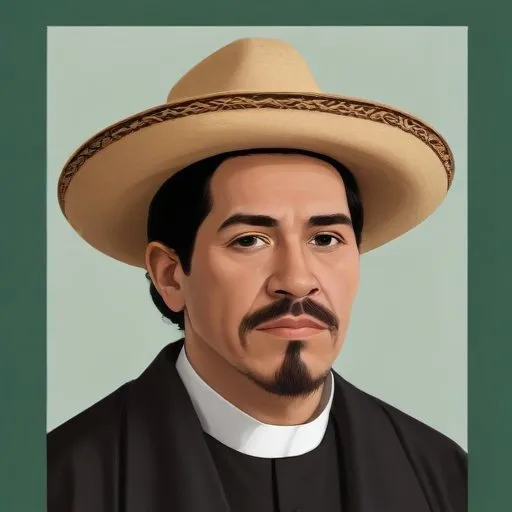
A 16th-century Nahua-Mexican evangelizer, theologian, and religious founder who blended indigenous and Christian beliefs, creating a unique religious movement that still influences Mexican culture today.
Margarito Bautista, a Mexican evangelist and religious founder, is renowned for his unwavering devotion to the Church of Jesus Christ of Latter-day Saints (LDS Church) and his subsequent breakaway movements. Through his writings and preachings, Bautista fused Book of Mormon doctrine with Mexican nationalism, propounding the notion that Mexicans held a birthright to lead the church and someday the world.
Bautista was born on June 10, 1878, in San Miguel de Atlautla, Mexico State, Mexico, to a bilingual family that spoke both Nahuatl and Spanish. Raised Catholic, Bautista was also exposed to the teachings of a Mexican Methodist minister, yet neither denominations satisfied his spiritual yearnings. His conversion to the LDS Church in 1901 marked a pivotal turning point in his life, as he dedicated the next three decades to preaching and writing for the church in Mexico and Utah.
Bautista's interpretations of LDS doctrine often found themselves at odds with the Anglo-American leaders of the church, who deemed his views as unorthodox. Despite this, his teachings resonated profoundly with Mexican Latter-day Saints, who saw in him a champion of their cultural and national identity. Bautista's advocacy for the reinstatement of early Mormon practices, such as the United Order and plural marriage, further strained his relationship with the church.
In response to the appointment of an Anglo-American mission president in Mexico, Bautista led a convention of Mexican Latter-day Saints in protest, which ultimately led to his excommunication from the church. Undeterred, Bautista joined the Third Convention breakaway movement, only to be expelled again for his insistence on reviving the United Order and plural marriage.
In 1947, Bautista founded a colonia called Colonia Industrial de la Nueva Jerusalén, where he established his own Mormon denomination. This new community allowed him to implement his vision of a self-sufficient, theocratic society, predicated on the principles of the United Order and plural marriage. Although the majority of the Third Convention reconciled with the LDS Church in 1946, Bautista remained steadfast in his convictions, refusing to rejoin the mainline church.
Bautista's personal life remains somewhat shrouded in mystery, with limited information available on his family and relationships. However, it is clear that his unwavering devotion to his faith and his people drove him to make immense personal sacrifices, often at great cost to his own well-being.
Bautista's life and teachings must be situated within the broader context of Mexican history, particularly during the tumultuous period of the Mexican Revolution. His emphasis on Mexican nationalism and cultural identity resonated deeply with a nation grappling with its own post-colonial identity.
Bautista's theology and praxis can be seen as part of a broader trend of religious innovation and revivalism in early 20th-century Mexico. His emphasis on cultural identity and national pride parallels the work of other religious leaders, such as José María Morelos y Pavón, who sought to indigenize Catholicism in Mexico.
Margarito Bautista's life and legacy serve as a powerful testament to the complexities of religious identity, cultural appropriation, and national pride. Through his unwavering devotion to his faith and his people, Bautista left an indelible mark on the history of Mormonism in Mexico, one that continues to resonate to this day.
Born in 1920
Leader of the Catholic Church from 1978 to 2005, known for helping to end communism in Poland and being a charismatic advocate for human rights and social justice.
89 Years Old
The leader of the Catholic Church, known for his progressive stance on social issues and efforts to reform the Church, inspiring millions worldwide.
