


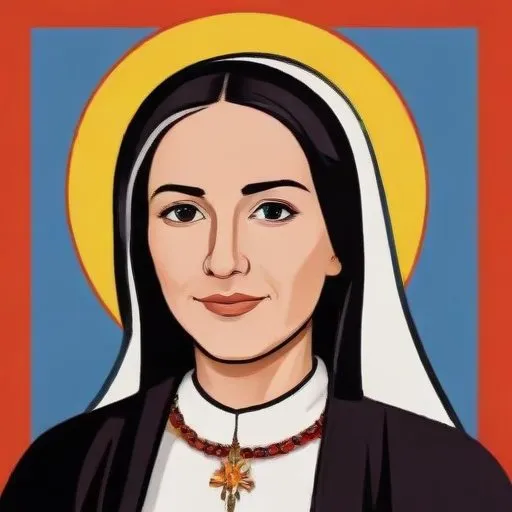
A 15th-century Spanish mystic and saint, known for her intense spiritual experiences, ecstasies, and visions, which were documented by her confessor and later used to promote her canonization.
Maria Angela Astorch is known for founding the Capuchin Poor Clares of Zaragoza and Murcia, and for her remarkable life story that includes a miraculous revival from death. She was a Spanish nun and mystic who lived from 1592 to 1665, leaving behind a legacy that would be recognized by the Catholic Church.
Born in Barcelona, Maria Angela Astorch was the youngest of four siblings. Her father, Cristbal Cortey, was a bookseller, and her mother, Catalina Astroch, was the universal heir of Pedro Miguel Astroch. Tragedy struck when both her parents died within four years, leaving Maria in the care of her housekeeper in Sarria.
In 1599, Maria was found poisoned and left for dead. Her sister Isabel, a nun in the Capuchin Monastery in Barcelona, attended the funeral along with the founder of the monastery, Angela Serafin Prat. Miraculously, Maria came back to life, and the event was attributed to the prayers of her sister Angela. This revival had a profound impact on Maria, giving her an advanced maturity and tremendous potential.
On September 16, 1603, at the age of 11, Maria entered the monastery of St. Margaret of Barcelona, founded by Mother Angela Serafina Prat. She was remarkable for her advanced knowledge, having already mastered the six volumes of the Breviary in Latin. Despite her early maturity, she had to wait until 1608 to be accepted as a nun, due to the recruitment policies of the monastery.
Maria's intellectual abilities and culture earned her the envy of her teacher, who eventually came to abuse her. However, Mother Angela Serafina recognized Maria's potential and deposed the teacher, placing Maria's sister Isabel in charge. Maria became a teacher herself on September 8, 1609.
Maria Angela Astorch's legacy extended beyond her monastery. She founded the Capuchin Poor Clares of Zaragoza and Murcia, leaving behind a lasting impact on the Catholic Church. Her remarkable life story and mystical experiences earned her recognition from the Catholic Church, and she was beatified by Pope John Paul II on May 23, 1982.
Maria Angela Astorch's contributions to the Catholic Church are undeniable. Her mystical experiences and remarkable life story have inspired generations of Catholics. Her founding of the Capuchin Poor Clares of Zaragoza and Murcia has left a lasting legacy in the Church.
Born in 1515
A 16th-century Spanish mystic and writer who introduced reforms to the Carmelite Order, promoting contemplative prayer and spiritual growth. Her writings are still widely read today.
Born in 1491
Founded the Jesuit Order, a Catholic religious organization known for its missionary and educational work, and developed the Spiritual Exercises, a guide for spiritual growth and discernment.
Born in 1506
Co-founder of the Society of Jesus, a Catholic religious order, known for his missionary work in Asia, especially in India and Japan, and for his role in the Counter-Reformation. He's revered for his tireless efforts to spread Christianity and his compassion for the poor and marginalized.
Born in 1581
A 17th-century French priest dedicated his life to serving the poor and marginalized, establishing a congregation of priests and nuns to provide aid and comfort to those in need. He's revered for his selfless charity and compassion.
Born in 1538
A 16th-century Italian reformer who played a key role in the Counter-Reformation, implementing significant reforms within the Catholic Church, and was known for his piety and charitable works.
Born in 1542
A 16th-century theologian and doctor of the Church, known for his writings on spirituality and his role in shaping Catholic doctrine. He was a key figure in the Counter-Reformation, defending Catholicism against Protestantism.
Born in 1559
A 16th-century Capuchin friar and Doctor of the Church, known for his exceptional preaching and writing skills, which helped to convert many to Christianity. He played a key role in the Counter-Reformation, strengthening the Catholic Church during a tumultuous period.
