


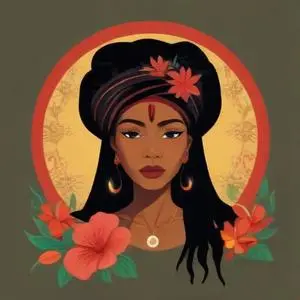
A legendary voodoo priestess who practiced and popularized African American folk magic in 19th-century New Orleans, known for her healing powers and spiritual influence.
Marie Laveau, the legendary Louisiana Creole, was renowned for her unparalleled mastery of Voodoo, herbalism, and midwifery, earning her the title of the Voodoo Queen of New Orleans. Her extraordinary abilities and charismatic presence captivated the hearts of many, cementing her status as a cultural icon in the vibrant city of New Orleans.
Born on September 10, 1801, in the French Quarter of New Orleans, Marie Catherine Laveau's early life was shrouded in mystery. Her mother, Marguerite D'Arcantel, was a free woman of color with African, European, and Native American ancestry, while her father's identity remained unknown due to inconsistent records.
On August 4, 1819, Marie married Jacques Paris, a free man of color, in a ceremony officiated by Father Antonio de Sedella, the renowned Capuchin priest Pre Antoine. The couple had two daughters, Flicit and Angle, who tragically died in childhood. Paris, a skilled carpenter, vanished from city records in 1822, leaving behind only whispers of his existence.
Marie Laveau's unique blend of Voodoo, herbalism, and midwifery catapulted her to fame in New Orleans. Her extraordinary abilities in healing, spiritual guidance, and conjure earned her the respect and admiration of the community. People from all walks of life flocked to her humble home on Rue St. Ann, seeking solace, protection, and healing from the enigmatic Voodoo Queen.
Marie Laveau's unwavering commitment to her people, faith, and community endeared her to the hearts of many. She practiced Voodoo as a means of empowerment, spirituality, and social justice, often using her remedies to protect the marginalized and oppressed. Her Roman Catholic faith harmoniously coexisted with her Voodoo practices, reflecting the rich cultural heritage of New Orleans.
Marie Laveau's legacy extends far beyond the confines of New Orleans. Her mystique has inspired countless works of art, literature, and music, solidifying her place in popular culture. The Voodoo Queen's enduring appeal lies in her embodiment of the complexities and contradictions of human experience, making her an unforgettable figure in American cultural history.
Marie Laveau's philosophical contributions revolved around the interconnectedness of spirituality, nature, and community. She firmly believed in the power of faith, the importance of social justice, and the need for self-empowerment. Her Voodoo practices embodied a distinct blend of African, European, and Native American spiritual traditions, reflecting the rich cultural diversity of New Orleans.
Marie Laveau's final resting place remains a mystery, with some believing she lies in the St. Louis Cemetery No. 1, while others claim she was buried in the Bayou St. John. One thing is certain – her remarkable life, legacy, and spirit continue to captivate the hearts of many, ensuring the Voodoo Queen of New Orleans remains an eternal icon of American cultural heritage.
