


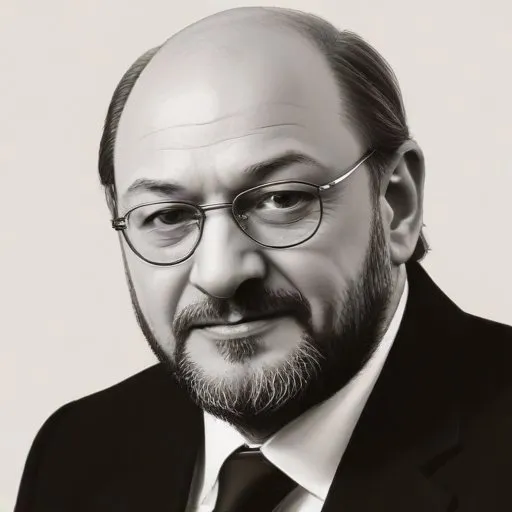
A German politician who served as President of the European Parliament and leader of the Social Democratic Party of Germany, known for his efforts to strengthen the European Union.
Martin Schulz is a prominent German politician known for his remarkable tenure as the President of the European Parliament and his leadership of the Social Democratic Party of Germany. With a political career spanning over three decades, Schulz has left an indelible mark on European politics.
Born on December 20, 1955, in Hehlrath, a village in western Rhineland, Germany, Schulz grew up in a family with strong social democratic roots. His father, Albert Schulz, was a local policeman, and his mother, Clara, was active in the Christian Democratic Union. This unique blend of political influences shaped Schulz's worldview from a young age.
Schulz's political journey began in 1994 when he was elected as a Member of the European Parliament (MEP). He quickly rose through the ranks, becoming the Leader of the Progressive Alliance of Socialists and Democrats from 2004 to 2012. His leadership skills and ability to forge alliances earned him the position of President of the European Parliament, a role he held from 2012 to 2017.
In 2016, Schulz announced his intention to stand as the Social Democratic Party (SPD) candidate for the German Chancellorship in the 2017 elections. Although the SPD suffered a significant defeat, Schulz's leadership skills were acknowledged, and he was appointed as the Foreign Minister of Germany in 2018.
Schulz's political career has not been without controversy. He faced criticism for his decision to step down as President of the European Parliament and later as leader of the SPD. Additionally, his leadership style and policies have been questioned by some.
Schulz is a strong advocate for European integration and social democracy. He has consistently emphasized the importance of strengthening the European Union and promoting social justice. His philosophical contributions have shaped the European political landscape, inspiring a new generation of leaders.
Martin Schulz's political legacy is a testament to his dedication to European integration and social democracy. His leadership and philosophical contributions have left a lasting impact on European politics, inspiring future generations of leaders to strive for a more united and just Europe.
71 Years Old
Luxembourg's Prime Minister from 1995 to 2013, known for his key role in shaping the European Union's economic and monetary policies. He was the President of the European Commission from 2014 to 2019, overseeing the EU's executive body.
72 Years Old
The first female Chancellor of Germany, serving for 16 years, known for her leadership during the European sovereign-debt crisis and her role in shaping the European Union's policy. She's a highly influential figure in modern politics.
72 Years Old
The 24th President of France, a key European leader who implemented significant economic reforms and played a crucial role in shaping the European Union's policies, particularly during the European sovereign-debt crisis.
51 Years Old
The 56th Prime Minister of Italy, serving from 2014 to 2016, known for his efforts to reform the Italian economy and politics, as well as his charismatic leadership style.
69 Years Old
The 14th Prime Minister of Poland, a journalist-turned-politician who played a key role in shaping the country's post-communist era and later became a prominent EU leader. He's known for his strong stance on European integration and criticism of authoritarianism.
48 Years Old
The 25th President of France is a centrist leader who has been a driving force behind the European Union and a strong advocate for climate action. He has implemented various reforms to modernize the French economy and has been a key player in international diplomacy.
73 Years Old
The 47th Prime Minister of Belgium, a prominent liberal politician who played a key role in shaping the European Union's policies and architecture. He's a strong advocate for a federal Europe and has been a vocal critic of nationalism.
