


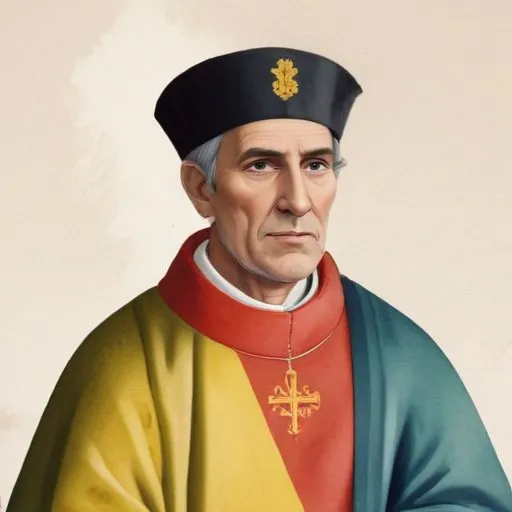
King of Aragon, Valencia, and Majorca who ruled from 1396 to 1410, known for his efforts to unify the Crown of Aragon and his role in the Western Schism.
Martin the Elder, also known as Martin the Humane and Martin the Ecclesiastic, was a prominent figure in the history of Spain and Italy, serving as the King of Aragon, Valencia, Sardinia, and Corsica, as well as the King of Sicily.
Martin was born in 1356 in either Girona or Perpignan, both then in the Principality of Catalonia. He was the second son of King Peter IV of Aragon and Eleanor of Sicily, princess of the Sicilian branch of the House of Aragon.
In 1372, Martin married Maria Lopez de Luna, daughter and heiress of Lope, Lord and 1st Count of Luna and Lord of Segorbe, and his wife Brianda de Got, who was born in Provence and was related to Pope Clement V.
In 1380, Martin's father appointed him lord and regent of the island of Sicily, then known as Trinacria, since its queen Maria of Sicily, who was also Martin's cousin, was underage.
In 1396, Martin succeeded his elder brother John I, who had died sonless, on the throne of Aragon. However, Sicilian nobles were causing unrest, and so Martin was kept in Sicily. Meanwhile, Martin's wife, Maria Lopez de Luna, claimed the throne on his behalf and acted as his representative until he arrived in 1397.
During his reign, Martin faced several challenges, including the contestation of his right to the throne by Count Matthew of Foix on behalf of his wife Joanna, elder daughter of John I. However, Martin succeeded in quashing an invasion by troops of the count.
Martin's reign marked the end of the House of Barcelona, as he failed to secure the accession of his illegitimate grandson, Frederic, Count of Luna.
Despite this, Martin's reign had a significant impact on the history of Aragon and Sicily, and he is remembered as a just and wise ruler.
Martin's reign was marked by a strong sense of justice and a commitment to the well-being of his people. He was known for his wisdom and fairness, and was popular among his subjects.
Despite facing many challenges during his reign, Martin remained committed to his duties as king and worked tirelessly to maintain peace and stability in his kingdoms.
Martin's reign can be compared to that of his contemporaries, such as King Henry III of Castile and King Louis II of Naples. While Martin's reign was marked by internal struggles and external threats, he was able to maintain stability and continuity in his kingdoms.
In contrast, King Henry III of Castile faced significant challenges during his reign, including the Black Death and conflicts with the nobility. King Louis II of Naples, on the other hand, was known for his military campaigns and expansionist policies.
Martin's legacy can still be seen in modern society, particularly in the regions he ruled. His commitment to justice and fairness has inspired generations of leaders and politicians.
Additionally, Martin's reign has had a lasting impact on the cultural and historical heritage of Aragon and Sicily, and continues to be studied and celebrated by historians and scholars today.
Born in 1208
Conqueror of Valencia and Mallorca, he united the Crown of Aragon and expanded its territories through military campaigns. He also promoted the Catalan language and culture.
Born in 1350
King of Aragon from 1387 to 1396, known for his tumultuous reign marked by conflicts with the nobility and the papacy. He was also a patron of the arts and literature.
Born in 1380
Unified the Crown of Aragon, ruling over a vast territory in eastern Spain, and sponsored the voyages of Christopher Columbus, leading to the discovery of the New World.
