


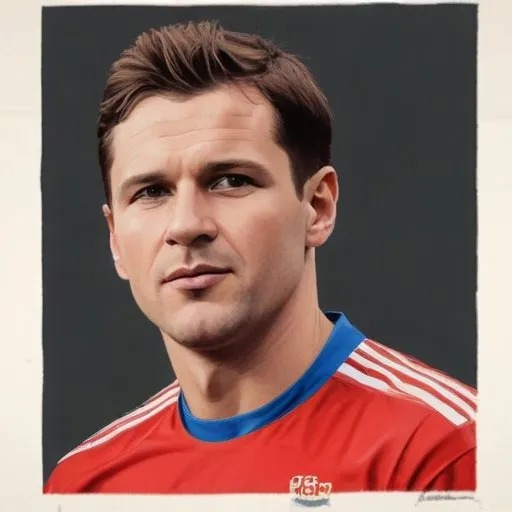
Austrian football legend and manager, known for his exceptional dribbling skills and leading the national team to several victories, including the 1934 World Cup semifinals.
Regarded as one of the greatest Austrian footballers of all time, Matthias Sindelar was a renowned centreforward who mesmerized fans with his exceptional dribbling skills and creativity on the field. He was the captain of the celebrated Austrian national side of the early 1930s, affectionately known as the Wunderteam, leading them to remarkable victories and earning the nickname "The Mozart of Football" or "Der Papierene" (The Paper Man) for his slight build.
Born on 10 February 1903 in Kozlov, Moravia, then part of the Austro-Hungarian Empire, Sindelar was of Czech descent. He moved to Vienna in 1905 with his family and grew up in the working-class district of Favoriten, where he developed a passion for football. Sindelar began playing football at a young age and joined his first club, Hertha Vienna, in 1918.
In 1924, Sindelar joined Austria Vienna, where he would spend most of his career, and quickly rose to prominence as a skilled and creative player. His exceptional skills and vision on the field earned him a place in the Austrian national team, which he would go on to captain at the 1934 World Cup.
Sindelar was an integral part of the Wunderteam, which became known for its innovative and fluid style of play, often referred to as the "Viennese whirlpool." This formation, which evolved into a 2-3-5 system, allowed for greater flexibility and creativity on the field, making the Austrian team a formidable force in international football.
Sindelar's individual technical skill and vision were unmatched in his time. His exceptional dribbling ability, coupled with his creative passing and shooting, made him a nightmare for opposing defenders. His vision on the field allowed him to read the game and create scoring opportunities for his teammates, making him a key element in the Wunderteam's success.
In 1999, Sindelar was voted the best Austrian footballer of the 20th century by the International Federation of Football History and Statistics (IFFHS). A year earlier, he was named Austria's sportsman of the century. His legacy continues to inspire generations of footballers, and his innovative style of play remains an integral part of the sport.
Sindelar's personal life was marked by tragedy. He died on 23 January 1939, at the age of 35, under mysterious circumstances. His death was shrouded in controversy, with some speculating that it was a suicide, while others believed it was a result of his involvement with the Austrian resistance against the Nazi occupation.
Sindelar's influence on modern football is still felt today. His innovative style of play, which emphasized creativity and fluidity, has inspired generations of footballers and coaches. His legacy continues to be celebrated, and his name remains synonymous with excellence and innovation in the sport.
