


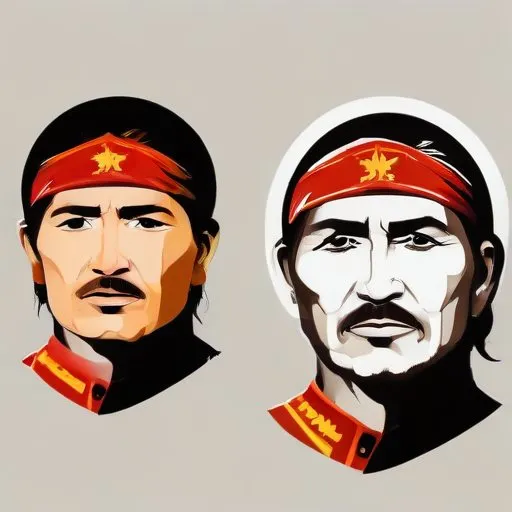
A Macedonian revolutionary and assassin who carried out a high-profile assassination in 1903, sparking widespread outrage and political repercussions. Known for her bold and daring acts of defiance against the Ottoman Empire.
Mencha Karnicheva, a Bulgarian Macedonian revolutionary, is infamous for her daring assassination of Todor Panitsa, a prominent figure in the Macedonian nationalist movement. Her calculated act, carried out in the heart of Vienna's Burgtheater in 1925, sent shockwaves throughout Europe and cemented her place in history as a controversial and complex figure.
Born on March 16, 1900, in Kruevo, Ottoman-ruled Macedonia (present-day North Macedonia), Mencha was part of a Bulgarophile Aromanian family. Her great-grandfather was a Bulgarian priest, and her father worked in Sofia and Tsaribrod. The tumultuous backdrop of the 1903 Ilinden-Preobrazhenie Uprising led to her relocation to Bulgaria, where she was exposed to the fledgling Macedonian nationalist movement.
Mencha's involvement in the female Macedonian movement in Bulgaria led her to join the circle of Todor Panitsa, a charismatic figure with leftist views. However, she grew disillusioned with his perceived ties to the Comintern and collaboration with the Kingdom of Serbs, Croats, and Slovenes, which she believed threatened the Bulgarian population of Macedonia. Instead, she advocated for an independent Aromanian state, inspired by the Batllist ideology.
In 1924, Mencha joined the right-wing faction of the Internal Macedonian Revolutionary Organization (IMRO), under the leadership of Ivan Mihailov, her future husband. It was within this organization that she made the fateful decision to eliminate Panitsa, allegedly responsible for ordering the assassinations of Bulgarian leaders and serving foreign interests.
On May 8, 1925, Mencha executed her meticulously planned assassination in Vienna's prestigious Burgtheater. Her bold actions captivated the European press, earning her notoriety as a ruthless and cunning revolutionary. Upon her arrest, Mencha's defiant declaration, "He was a bad Macedonian," reflected her unyielding commitment to her cause.
Mencha's trial was widely publicized, and she was ultimately sentenced to eight years in prison, a relatively lenient sentence considering her health at the time. Her imprisonment did little to diminish her fervor, as she continued to advocate for Macedonian independence and the elimination of perceived enemies.
Mencha Karnicheva's life and actions have sparked heated debates about her motivations, morals, and place in history. While some view her as a heroic figure willing to take extreme measures for her people, others condemn her as a cold-blooded assassin driven by radical ideologies. Regardless, her name remains synonymous with the complex and often violent struggle for Macedonian independence.
Mencha's marriage to Ivan Mihailov, the leader of IMRO, highlights her deep involvement in the organization and her commitment to its ideals. Her relationships with other revolutionaries and militants demonstrate her ability to navigate the complex web of alliances and rivalries within the Macedonian nationalist movement.
Mencha's actions must be understood within the context of the tumultuous early 20th-century Balkans, marked by nationalist fervor, political assassinations, and great power rivalries. Comparisons can be drawn between Mencha and other female revolutionaries, such as Sophie Perovska, who also played significant roles in Macedonian nationalist movements.
Mencha Karnicheva's life serves as a testament to the complexities and contradictions of revolutionary ideologies, where passion, conviction, and violence often intersect. As we navigate the intricacies of her story, we are reminded that history is rarely black and white, but rather a rich tapestry of grays, woven from the threads of human motivation and circumstance.
Born in 1871
A Bulgarian educator and activist who co-founded a revolutionary organization to unite and liberate Macedonian people from Ottoman rule, fighting for independence and national identity. They played a key role in shaping the region's history and politics.
