


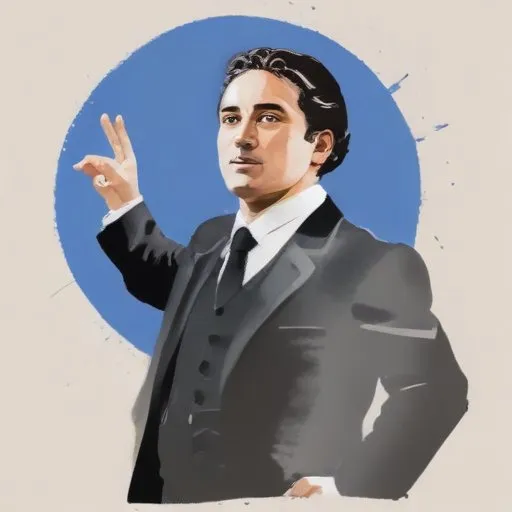
A 19th-century maestro who led the Royal Opera House and composed operas, earning acclaim for his innovative productions and orchestral works.
Michael Costa, born Michele Andrea Agniello Costa, was a renowned Italian-born conductor and composer who made a significant impact on the English music scene in the 19th century. He is best known for his work as the conductor of the Royal Italian Opera at Her Majesty's Theatre, where he introduced many iconic operas to English audiences and paved the way for future generations of opera enthusiasts.
Born on February 14, 1808, in Naples, Italy, Costa came from a family of Sephardic Jewish descent. He began his musical training at a young age, studying with his father and later at the Real Collegio di Musica under the guidance of Niccolò Antonio Zingarelli.
In 1829, Costa traveled to England to conduct Zingarelli's Cantata Sacra at the Birmingham Music Festival. Although his debut was met with criticism, he persevered and eventually settled in England, where he worked at His Majesty's Theatre in London.
Costa's big break came in 1830 when he became the conductor of the Royal Italian Opera at Her Majesty's Theatre. During his tenure, he introduced many iconic operas to English audiences, including Verdi's Nabucco and Ernani, as well as Rossini's William Tell.
Costa's influence on English opera was profound. He championed the works of Italian composers, introducing English audiences to the dramatic and expressive styles of Verdi, Rossini, and Bellini. His efforts helped to popularize opera in England, paving the way for future generations of opera enthusiasts.
Costa's legacy extends beyond his own musical compositions. He played a significant role in shaping the English opera scene, introducing new works and promoting the careers of prominent singers. He also exerted real influence for change as a conductor, advocating for reforms in the English opera industry.
Costa married in 1833 and had three children. He was knighted in 1869 for his services to music and was awarded the Royal Philharmonic Society's gold medal in 1871.
Although Costa's own compositions are not as well-known today, he wrote a significant amount of music, including operas, symphonies, and cantatas. His most notable work is the opera Malek Adhel, which premiered in 1837.
Costa faced criticism for his conducting style, which was often described as rigid and lacking in expressiveness. He was also known to be a demanding and exacting conductor, which led to conflicts with singers and orchestra members.
Costa was known for his wit and humor. One of his most famous quotes is "Music is the silence between the notes." This quote reflects his emphasis on the importance of rhythm and timing in music.
Costa's legacy is deeply rooted in the historical context of 19th-century England. He played a significant role in promoting Italian opera in England, paving the way for future generations of opera enthusiasts. His influence can be seen in the many opera houses and companies that followed in his footsteps.
Costa died on April 29, 1884, at the age of 76, leaving behind a legacy that continues to shape the English opera scene to this day.
Born in 1792
Operatic mastermind behind iconic comedies like "The Barber of Seville" and "William Tell," crafting catchy, witty, and playful music that still delights audiences today.
Born in 1797
A renowned Italian composer of the Romantic era, best known for his operas, particularly "L'elisir d'amore" and "Don Pasquale", which are still widely performed today.
Born in 1801
Operatic mastermind behind bel canto classics like "Norma" and "La Sonnambula", renowned for their beautiful, expressive melodies and dramatic flair.
Born in 1813
A renowned composer of iconic operas like La Traviata and Aida, known for his masterful blending of drama and music. His works continue to captivate audiences worldwide.
Born in 1813
A revolutionary composer who transformed opera with his epic, mythological works, creating a new era of musical storytelling. His iconic operas, such as "Der Ring des Nibelungen," continue to captivate audiences worldwide.
Born in 1809
A renowned 19th-century musician who masterfully blended classical and romantic styles, creating iconic works like the "Wedding March" and "Elijah" oratorio. His compositions continue to inspire and influence generations of artists.
Born in 1810
A renowned Romantic-era composer and influential music critic, known for his expressive and emotionally charged works, including symphonies, piano music, and art songs.
Born in 1833
A renowned pianist and composer, he crafted complex, expressive works that blended traditional and innovative techniques, leaving an indelible mark on classical music.
