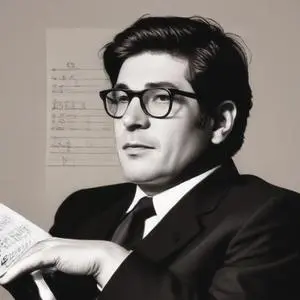
Morton Feldman

Morton Feldman

Morton Feldman was born on January 12th, 1926

Full Name: Morton Feldman
Born: January 12, 1926
Place of Birth: New York City, USA
Died: September 3, 1987
Profession: Composer, Academic
Genre: Classical, Experimental
Known For: Indeterminacy, Graphic Scores
Influence: John Cage, Karlheinz Stockhausen

A pioneer of indeterminacy in music, creating subtle, atmospheric soundscapes that defy traditional composition, and teaching generations of musicians to think outside the box.

Timeline
1926
Born in New York
Morton Feldman was born on January 12, 1926, in New York City, USA.
1949
Studied with Stefan Wolpe
Feldman studied composition with Stefan Wolpe from 1949 to 1954, developing his unique musical style.
1950
Associated with the New York School
Feldman was associated with the New York School of composers, including John Cage, Christian Wolff, and Earle Brown, in the 1950s.
1972
Composed Rothko Chapel
Feldman composed Rothko Chapel in 1972, a work inspired by the art of Mark Rothko and the Rothko Chapel in Houston, Texas.
1987
Died at Age 61
Morton Feldman died on September 3, 1987, at the age of 61, in Buffalo, New York.
Morton Feldman

Morton Feldman Quiz

Morton Feldman's music is characterized by its use of

Score: 0/5
FAQ
What was Morton Feldmans most notable work as a composer?
Morton Feldmans most notable work as a composer is his piece Rothko Chapel, which premiered in 1972. This work is considered a masterpiece of contemporary classical music and is known for its haunting beauty and simplicity.
What was Morton Feldmans role in the New York School?
Morton Feldman was a key figure in the New York School, a group of avant-garde composers who emerged in the 1950s. Along with John Cage, Earle Brown, and Christian Wolff, Feldman pushed the boundaries of modern classical music.
What awards did Morton Feldman receive for his work?
Morton Feldman received several awards for his work, including a Guggenheim Fellowship and a grant from the National Endowment for the Arts. He was also awarded the Prix de Rome in 1967.
What was Morton Feldmans teaching career like?
Morton Feldmans teaching career was marked by stints at several institutions, including the University at Buffalo and the New York Studio School. He was known for his unorthodox teaching style, which emphasized experimentation and creative freedom.
What is Morton Feldmans legacy in classical music?
Morton Feldmans legacy in classical music is that of a visionary composer who expanded the possibilities of modern classical music. He is remembered for his innovative and often provocative works, which continue to inspire composers and musicians today.

Related People:

Pierre Boulez

Born in 1925

A renowned French musician who revolutionized classical music with his avant-garde compositions and innovative conducting style, pushing boundaries and redefining the genre.

Karlheinz Stockhausen

97 Years Old

A pioneer of electronic and avant-garde music, this composer pushed boundaries with unconventional sounds and performances, influencing generations of musicians and artists.

John Cale

84 Years Old

A visionary musician and producer who co-founded The Velvet Underground, pushing boundaries in rock music and influencing generations of artists. Known for experimental and avant-garde work .

Elliott Carter

Born in 1908

A pioneering composer of modern classical music, known for his complex and innovative works that pushed the boundaries of harmony and rhythm.

George Crumb

96 Years Old

A pioneer of avant-garde music, this composer and educator is renowned for his innovative and theatrical works that often feature unconventional instruments and techniques.

Toru Takemitsu

95 Years Old

A renowned Japanese composer and music theorist, blending Eastern and Western styles to create innovative, evocative soundscapes for film and concert halls.

Steve Reich

89 Years Old

A pioneer of minimalism, creating hypnotic, repetitive patterns that redefine classical music, influencing generations of musicians and composers.

Philip Glass

89 Years Old

A pioneer of minimalist music, creating hypnotic, repetitive patterns that revolutionized classical music and influenced film scores and popular culture.