


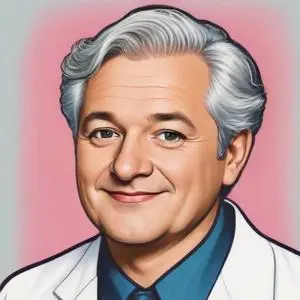
A renowned geneticist and biologist who discovered the cyclin-dependent kinases, a crucial component of cell cycle regulation, earning a Nobel Prize in Physiology or Medicine in 2001.
Paul Nurse is renowned for his groundbreaking discoveries in the field of genetics, particularly his work on the protein molecules that control the division of cells in the cell cycle. This pioneering research, carried out in conjunction with Leland Hartwell and Tim Hunt, earned him the prestigious Nobel Prize in Physiology or Medicine in 2001.
A surprising twist marks Nurse's early life: his mother's efforts to conceal his illegitimacy led to a remarkable family dynamic. For most of his life, Nurse believed his maternal grandmother was his mother and his mother was his sister. This poignant revelation came to him in his 50s, long after his parents had passed away.
Despite this unusual beginning, Nurse excelled academically. He attended Lyon Park school in Alperton and Harrow County Grammar School, before earning his BSc degree in Biology from the University of Birmingham in 1970. He proceeded to obtain his PhD degree in 1973 from the University of East Anglia, conducting research on Candida utilis.
Nurse's postdoctoral research took him to the University of Bern, the University of Edinburgh, and the University of Sussex. During this period, he worked at the laboratory of Murdoch Mitchison at the University of Edinburgh, where he identified the gene cdc2 in fission yeast between 1973 and 1979.
In 2000, Nurse became the President of the Royal Society, a position he held until 2015. He currently serves as the Chief Executive and Director of the Francis Crick Institute.
Nurse's work has far-reaching implications for our understanding of cell division and its role in disease. His research has paved the way for novel approaches to cancer treatment and a deeper comprehension of cellular processes.
Nurse has spoken extensively on the importance of basic scientific research and its potential to drive innovation. He has also emphasized the need for greater collaboration between scientists, policymakers, and industry leaders to tackle global challenges.
Paul Nurse's contributions to the field of genetics have been profound, and his influence extends beyond the scientific community. As a champion of basic research and collaboration, he continues to inspire new generations of scientists and thinkers.
His visionary leadership has shaped the Francis Crick Institute, a beacon of interdisciplinary research, and his commitment to advancing our understanding of cell biology has left an indelible mark on modern science.
83 Years Old
A British biochemist and academic who discovered the cyclin-dependent kinases, a crucial component in cell division, earning him a Nobel Prize in Physiology or Medicine in 2001.
86 Years Old
Discovered key regulators of the cell cycle, earning a Nobel Prize in Physiology or Medicine in 2001 for his groundbreaking work on the mechanisms that govern cell division. His research has far-reaching implications for cancer treatment and understanding cellular development.
99 Years Old
Pioneering molecular biologist who deciphered the genetic code and developed a new field of study, earning a Nobel Prize in Physiology or Medicine in 2002.
Born in 1916
Pioneering scientist who discovered the structure of DNA, revolutionizing our understanding of genetics and life itself.
98 Years Old
Discovered the structure of DNA, revolutionizing our understanding of genetics and earning a Nobel Prize. Pioneering work in molecular biology has far-reaching implications for medicine and beyond.
Born in 1920
A British scientist who contributed significantly to the discovery of the structure of DNA, providing high-quality X-ray crystallography images that helped James Watson and Francis Crick develop their famous model.
Born in 1916
A Nobel Prize-winning physicist and biologist who contributed significantly to the discovery of the structure of DNA, using X-ray crystallography to produce the first clear images of the molecule.
84 Years Old
A Nobel Prize-winning biologist who led the team that sequenced the human genome, making groundbreaking discoveries in the field of genetics.
